Materials, Design & Development, Quality & Testing, Regulation & Standards
Application-Specific Biocompatibility Assessment: Why a Material Is Not Biocompatible by Itself
Updated
A resin, alloy, silicone, or coating is not simply “biocompatible.” Its biological safety depends on how it appears in a finished medical device, where that device is used, how long contact lasts, what may be released from it, and how the body responds.
That is the practical basis of an application-specific biocompatibility assessment. It prevents a common development mistake: treating a supplier data sheet, a prior test report, or a history of use for a raw material as proof that every device made from that material is biologically safe.
Biocompatibility describes a relationship, not a label
Biocompatibility is commonly understood as the ability of a medical device to perform with an appropriate host response in its intended application. The words appropriate, host response, and intended application matter.
A material may be appropriate in one use and unsuitable in another. For example, a polymer used in a brief-contact external device does not automatically have adequate evidence for a long-term implant. A metal alloy with an acceptable history in bone fixation may need a different evaluation when used in a blood-contacting component. A coating that is safe on an intact-skin electrode may not be suitable for contact with damaged skin or mucosal tissue.
The relevant system is therefore:
- the material and its formulation;
- the finished device and all patient-contacting components;
- manufacturing, cleaning, packaging, and sterilization;
- the type, route, frequency, and duration of body contact;
- the patient tissue, physiological environment, and foreseeable clinical use.
This does not mean that prior material knowledge has no value. It is often highly useful. But it is evidence to be assessed for relevance, rather than a transferable approval for every new device application.
Why the same material can produce different biological risks
Several factors can change the biological risk profile without changing the material name on a bill of materials.
Contact site changes the relevant hazards
Contact with intact skin, breached skin, mucosal membrane, circulating blood, tissue, bone, or the central nervous system presents different biological questions. Blood-contacting devices may require consideration of interactions involving thrombosis, coagulation, platelets, complement, and blood cells. An implantable device may require assessment of local tissue effects, degradation, and long-term systemic exposure.
A material cannot be called safe in the abstract when the tissue environment is unspecified.
Duration and cumulative exposure matter
A component used for a few minutes in a diagnostic procedure does not create the same exposure as a device used continuously for weeks or permanently implanted. Duration is not always the time a single component touches the patient. For devices used repeatedly or replaced during treatment, the cumulative patient-contact time may be the meaningful exposure.
Longer exposure can change the importance of endpoints such as sensitization, systemic toxicity, implantation response, degradation, or chronic effects. It can also increase the significance of low-level substances released over time.
Geometry and physical form affect tissue response
The same polymer can be a smooth molded housing, a porous scaffold, a thin film, a fiber, a particulate, or a wear surface. These forms differ in surface area, friction, tissue integration, particle generation, and the amount of material available for extraction.
A device can also change physically in use. Flexing, abrasion, corrosion, hydrolysis, fatigue, or mechanical failure can produce particles, debris, or new exposed surfaces. These are device-level risks, not properties that can be fully resolved by a raw-material certificate.
Processing can alter what the patient encounters
The material delivered by a resin supplier is not necessarily the material that contacts the patient. Processing may introduce or alter substances through:
- colorants, plasticizers, stabilizers, catalysts, and curing agents;
- mold-release agents, machining lubricants, coolants, and cleaning agents;
- adhesives, inks, coatings, and overmolded components;
- residual monomers, solvents, or processing aids;
- sterilization residues or sterilization-induced chemical changes;
- degradation during storage, transport, or aging.
Even a change that improves manufacturing yield can affect the chemical profile of the finished device. That is why a claim such as “medical-grade material” is a starting point for review, not a biological safety conclusion.
The finished device is the primary evaluation object
Biological evaluation should center on the final finished device or on a scientifically justified representative test article. This principle is especially important for assemblies.
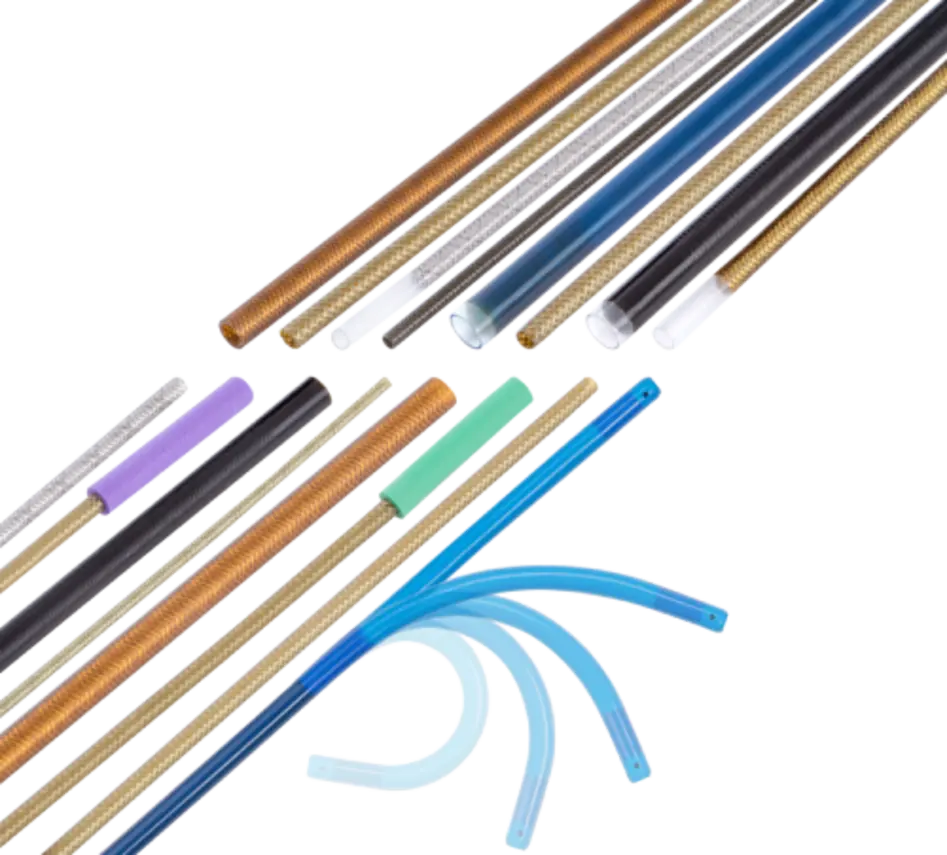
Consider a catheter shaft made from a familiar polymer. The shaft may also include a tie layer, radiopaque filler, hydrophilic coating, marker band, adhesive joint, printing ink, and packaging system. Each part may have acceptable individual data, while the finished device can still have a different extractables profile because components interact during processing, sterilization, or storage.
The finished configuration also determines which surfaces are exposed. A material fully enclosed within a device may present a very different patient exposure from the same material used on an external surface or in a fluid path.
A useful device description for biological evaluation identifies:
| Device factor | Questions to answer |
|---|---|
| Patient contact | Is contact direct or indirect? Which tissue or fluid is involved? |
| Contact duration | Is exposure limited, prolonged, long-term, repeated, or cumulative? |
| Contacting components | Which materials, coatings, lubricants, inks, and adhesives can reach the patient? |
| Physical condition | Is the contact surface smooth, porous, absorbable, degradable, load-bearing, or subject to wear? |
| Clinical environment | Will the device see blood, wound fluid, urine, gastric fluid, bone, or another challenging environment? |
| Lifecycle condition | Is the device assessed after sterilization, shelf aging, simulated use, and foreseeable damage where relevant? |
Material history is useful only when it is genuinely comparable
Existing information can reduce unnecessary testing, but comparability must be demonstrated rather than assumed. A prior study or clinical history is more persuasive when the new device has the same or a demonstrably more favorable:
- material identity and formulation;
- supplier specification and impurity profile;
- physical form and exposed surface area;
- patient-contact type and duration;
- manufacturing and post-processing conditions;
- sterilization method and packaging configuration;
- storage conditions and shelf-life state.
Small differences can matter. A new pigment may introduce an impurity. A revised cure cycle can change residual levels. A different sterilization method can alter polymer chemistry. Moving to a new supplier may change additive packages or trace contaminants despite an identical trade name or general material specification.
The question is not whether the material has been used in medicine before. The question is whether the available evidence represents this specific device in its finished, clinically relevant condition.
Start with risk assessment, not a standard test package
ISO 10993-1 frames biological evaluation within a risk management process. It is not intended to be a fixed checklist in which every device receives the same set of tests.
A practical workflow begins by defining the clinical exposure and identifying potential biological hazards. The team can then decide, endpoint by endpoint, whether the concern is addressed through existing data, chemical characterization, toxicological assessment, biological testing, or a combination of these methods.
Build a biological evaluation plan early
A Biological Evaluation Plan should be prepared before samples are sent to a laboratory. At minimum, it should connect the following information:
- Intended use and patient population. Define the clinical procedure, use environment, contact route, and foreseeable duration.
- Full material inventory. Include patient-contacting materials and substances that may migrate to the patient from adjacent components or fluid paths.
- Manufacturing process map. Identify processing aids, cleaning steps, coatings, assembly materials, packaging, and sterilization.
- Contact classification. Categorize the nature and duration of contact and identify the biological endpoints that need to be addressed.
- Existing evidence review. Assess material, test, clinical, and post-market information for relevance to the finished device.
- Gap assessment. Define what must be characterized, justified, or tested to reach an acceptable residual risk conclusion.
This structure avoids a costly pattern: ordering biological tests first, then discovering that an uncharacterized coating, residue, or sterilization effect makes the test article unrepresentative.
Chemical characterization connects materials to patient exposure
Chemical characterization is particularly important because it addresses what can be released from the finished device. It may identify extractable compounds, support assessment of potential leachables, and provide the basis for a toxicological risk assessment.
It does not replace every biological endpoint automatically. Its value is that it makes the assessment more specific. Instead of relying only on broad statements about a polymer family, the team can evaluate identified substances, potential patient dose, route of exposure, and margin of safety in the actual device context.
Chemical characterization should be planned carefully. Extraction conditions, solvents, temperature, time, sample preparation, and surface-area-to-volume ratio affect what is found. The approach needs to be relevant to the intended use while also suitable for identifying potential chemical hazards. Results must be interpreted by considering clinical exposure, not merely by listing detected peaks.
For a complex or novel device, characterization may reveal that a targeted test, process control, supplier restriction, or design change is more appropriate than a large untargeted testing program.
Manufacturing changes can invalidate a previous conclusion
Biocompatibility evidence should be tied to change control. A biological evaluation is not permanently valid because a device once passed testing.
Changes that should trigger documented reassessment include:
- a new raw-material supplier or revised material specification;
- formulation, colorant, filler, or additive changes;
- a change in molding, curing, bonding, printing, coating, cleaning, or machining;
- new process aids, detergents, or lubricants;
- sterilization, packaging, or shelf-life changes;
- a design change that alters exposed surface area, fluid path, or contact type;
- a new clinical indication, contact duration, or patient population;
- new complaint, vigilance, clinical, or post-market information indicating a possible biological issue.
Not every change requires repeating every study. The correct response is a risk-based reassessment. It should determine whether the change affects chemical composition, patient exposure, physical behavior, degradation, or the applicability of existing evidence.
Common material-selection mistakes
Treating “medical grade” as a regulatory status
“Medical grade” can indicate a supplier’s intended market, quality controls, or available documentation. It does not establish that the final device is biologically safe for every contact type, duration, or sterilization method.
Testing a convenient sample instead of the worst-case device
A test article that omits a coating, adhesive, pigment, or sterilization step may not represent the clinical product. Select samples that capture the highest reasonable biological risk, and document why they are representative of the product family.
Focusing only on bulk material properties
Bulk chemistry and mechanical properties matter, but interfaces often drive biological response. Surface finish, wear, corrosion, extractables, degradation products, and particles may be more relevant than the nominal base material.
Copying evidence from a predicate or legacy device without comparison
Prior evidence can be powerful, but only if the new product is equivalent in the features that affect biological exposure. A material name match alone is not enough.
A better question for development teams
Instead of asking, “Is this material biocompatible?” ask:
Is this finished device, manufactured and sterilized as specified, biologically acceptable for its intended patient contact and duration of use?
That question naturally leads to better design decisions. It directs attention to the contacting configuration, the chemical and physical changes introduced by manufacturing, the relevant biological endpoints, and the evidence needed to support residual risk acceptability.
For material selection, this approach does not make development slower by definition. It can prevent late redesign, repeated testing, and regulatory questions caused by weak assumptions. The earlier the device-material-host system is defined, the easier it is to choose materials, control processes, and generate evidence that actually applies to the product being placed on the market.