Manufacturing, Quality & Testing, Regulation & Standards
Cleanroom Validation Testing: Which Tests Prove Control Beyond Particle Counts?
Updated
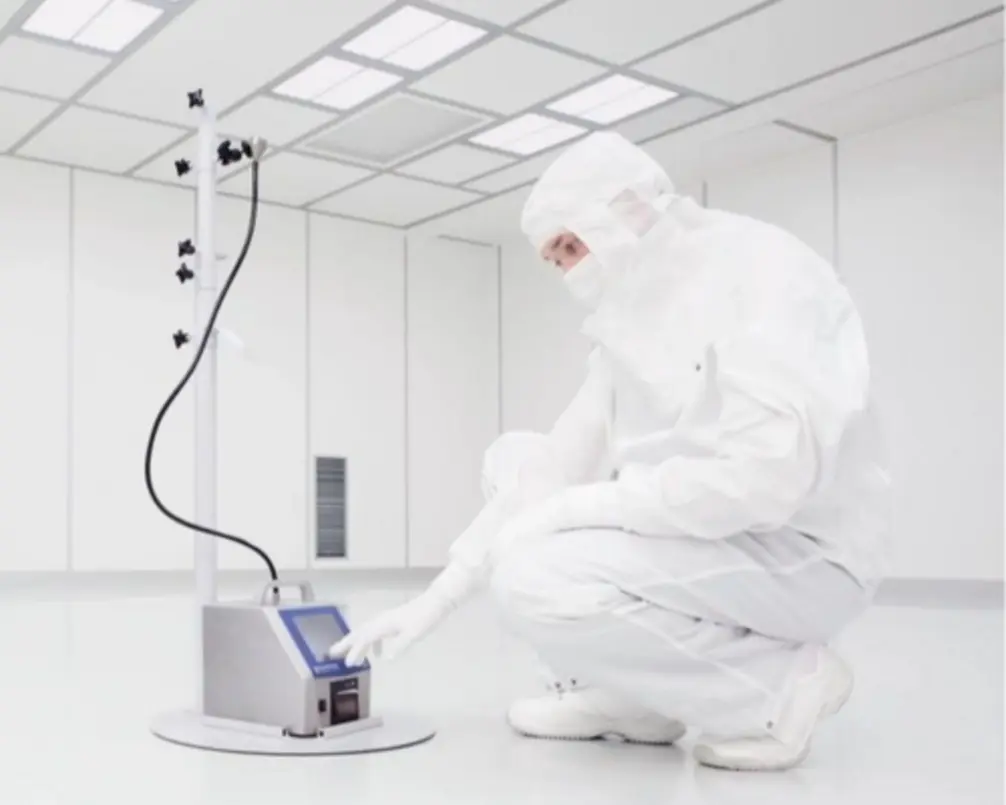
An ISO cleanroom classification is important, but it is only one part of a defensible environmental-control programme. Particle counts show the concentration of airborne particles at defined locations and a defined time. They do not, by themselves, show whether clean air reaches the critical work area, whether a ceiling filter leaks, whether pressure reverses when a door opens, or whether the room returns to control after a disturbance.
Effective cleanroom validation testing links the room’s intended use, contamination risks, facility design, operating procedures and test evidence. The result should demonstrate more than a passing count: it should show that the cleanroom can consistently protect the device, component, packaging system or process it was designed to support.
Start with the question each standard answers
ISO 14644 is often treated as a single requirement, but its parts have different roles.
- ISO 14644-1 classifies air cleanliness by airborne particle concentration. This is the source of ISO Class 5, 7 or 8 particle limits.
- ISO 14644-2 addresses monitoring needed to provide evidence that cleanroom performance is maintained over time.
- ISO 14644-3 provides test methods for evaluating performance characteristics such as installed-filter leakage, airflow, pressure difference, airflow direction and recovery.
- ISO 14644-4 addresses design, construction and start-up considerations.
- ISO 14644-5 addresses operations, including people, materials, cleaning and management of the controlled environment.
For a medical device manufacturer, these standards need to sit within the quality system and product-specific risk management. The required scope is not determined by the ISO class alone. A room used to assemble a non-sterile component may need a different evidence package from a room handling an exposed sterile barrier system, a drug-device combination product or a process with microbial-control requirements.
Define the intended use before writing a protocol. Identify what must be protected, where it is exposed, the principal contamination routes, and which conditions could affect product quality. Then set acceptance criteria before testing begins. A criterion selected after a result is known is difficult to justify.
What particle counts prove—and what they do not
Airborne particle counting remains central because it establishes or confirms the ISO classification specified for the space. A properly executed classification test uses suitable calibrated equipment, defined particle sizes, sample volumes, locations and occupancy state. Each sampling location must meet the applicable limit.
However, a satisfactory particle count is a snapshot. It does not necessarily reveal:
- A leak or bypass path around an installed HEPA or ULPA filter.
- Poor airflow distribution at a critical workstation.
- Turbulence caused by equipment, operators or material staging.
- Ingress from a corridor or lower-grade adjacent area.
- Inadequate HVAC capacity following a disturbance.
- A temperature or humidity excursion that affects materials, adhesives, electronics or packaging processes.
Particle counts should therefore be treated as one outcome measure in a broader qualification package, not as proof that every contamination-control function is working.
The tests that usually sit beside particle counting
The exact test set should follow risk assessment, user requirements, room design and applicable regulatory expectations. The tests below answer different control questions and commonly form the technical core of cleanroom validation testing.
| Test | Main question answered | Typical reason to include it |
|---|---|---|
| Particle count | Does the air meet the specified ISO class? | Classification and periodic reconfirmation |
| Installed-filter integrity | Are filters, frames, seals and housings free from unacceptable leaks or bypass? | After installation, repair, replacement and on a justified schedule |
| Airflow volume, velocity or air-change rate | Is the HVAC system delivering the designed quantity of air? | Balancing, troubleshooting and demonstrating ventilation capacity |
| Pressure differential | Does air move from cleaner to less-clean areas as intended? | Maintaining zoning and limiting ingress |
| Airflow visualization | Does air move safely around people, equipment and exposed product? | Identifying turbulence, dead zones and contamination paths |
| Recovery | How quickly does the room return to a defined condition after a challenge or disturbance? | Demonstrating dilution and removal capability where relevant |
| Temperature and relative humidity | Are conditions suitable for the process, materials and operator controls? | Product and process requirements, not ISO class alone |
Installed HEPA or ULPA filter integrity
An installed-filter integrity test is not the same as a filter manufacturer’s efficiency certificate. Factory testing supports procurement, but it cannot prove that the filter arrived undamaged, was installed correctly or remains sealed in its final housing.
The in-place test evaluates the filter media and the installed system, including frame, gasket, seal and likely bypass paths. The approved method should define the challenge aerosol or alternative method, instrument, upstream condition, scan pattern, scan rate and acceptance criterion.
Do not assume one leakage percentage is universally appropriate. The criterion must match the filter grade, test method, system design and approved specification. Any repair needs documented assessment and retesting. Include a filter map in the report so each tested filter can be traced to its physical location.
Airflow volume, velocity and air changes
Airflow testing demonstrates that the HVAC system is delivering air as designed. In a non-unidirectional cleanroom, air-change rate is often useful for balancing and system verification. It also supports an assessment of dilution, heat removal, pressure control and recovery performance.
It is not, however, a universal cleanliness acceptance limit. There is no single air-change rate that proves every ISO 7 or ISO 8 medical device room is controlled. A room’s required airflow depends on its volume, heat load, occupancy, exhaust demand, filter arrangement, room layout, pressure cascade and process risks.
For unidirectional airflow, velocity and uniformity matter particularly at the working position. Measurements close to a supply filter do not prove that air protects the exposed product below. Use the design specification and contamination-control rationale to define suitable locations and acceptance criteria.
Pressure differential and airflow direction
Pressure differentials provide a driving force for air to travel from cleaner areas toward less-clean areas. This supports room segregation and reduces the likelihood of contaminants entering through gaps, door openings and pass-throughs.
A pressure reading with all doors closed is necessary but incomplete. Qualification should also examine the conditions that challenge the pressure cascade, such as door operation, interlock sequencing, material transfer, exhaust changes and loss of supply air where relevant.
The protocol should specify which pressure boundaries are critical, normal setpoints, alert or alarm limits, instrument accuracy, alarm response and acceptable stabilization time. A common nominal pressure difference is not automatically suitable for every building. The appropriate value depends on the zoning plan, door configuration, airflow balance and the consequence of ingress.
Airflow visualization: make the smoke study represent reality
Airflow visualization, often called a smoke study, makes airflow patterns visible. It can show whether supply air reaches the intended area, whether a person blocks first air, whether air sweeps across a contamination source before reaching product, or whether recirculation occurs behind equipment.
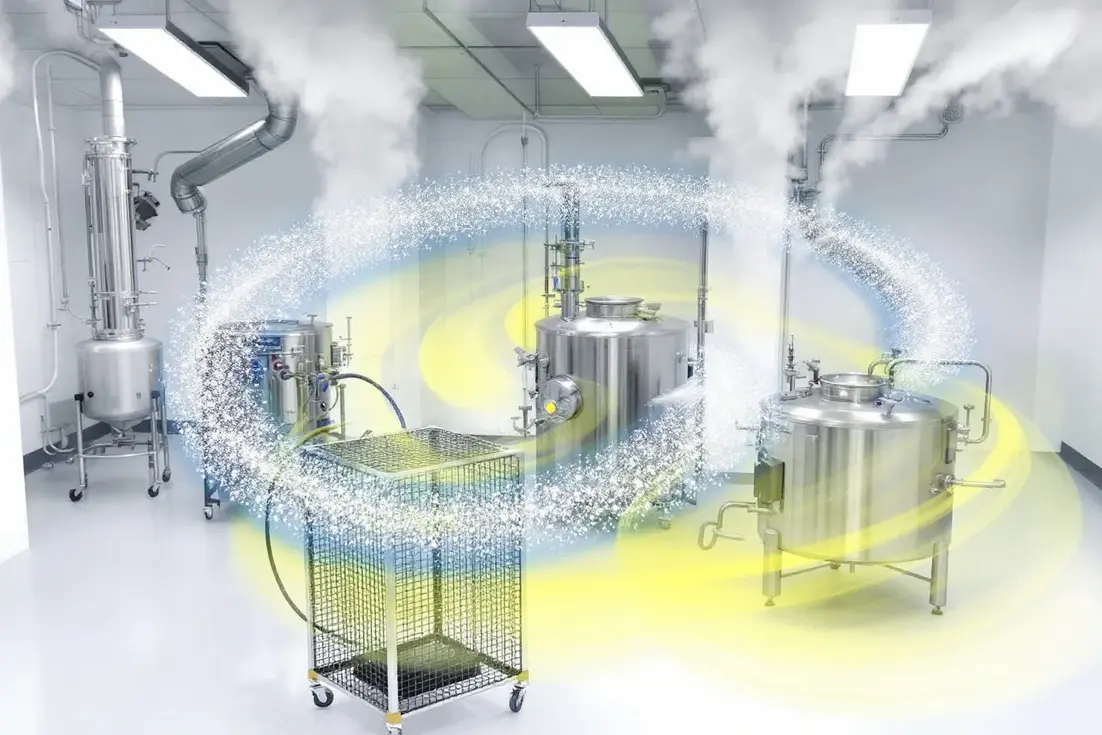
The most useful studies are linked to the process. Test the actual workstation arrangement, typical equipment, normal operator positions, material presentation and defined interventions. Include credible worst-case conditions rather than filming an empty room with no meaningful obstruction.
For each scenario, retain identified video records and observations. Document the release point, room configuration, equipment status, operator activity, conclusion and any corrective actions. If the study exposes an undesirable path, do not rely on a passing particle count to dismiss it. Change the layout, process, airflow balance or work practice, then repeat the study as needed.
Recovery testing
A recovery test evaluates how quickly a room returns to a defined condition after a controlled particle challenge or other documented disturbance. It can help demonstrate whether the ventilation system dilutes and removes contamination effectively.
Recovery is not required simply to hold an ISO 14644-1 particle classification. It is a test method that becomes appropriate when required by a regulation, customer requirement, internal specification or risk assessment. It is particularly useful where the process depends on a defined recovery period after door openings, maintenance, cleaning or an upset condition.
The protocol needs a clear starting condition, challenge method, endpoint, time measurement and acceptance criterion. Without these elements, a recovery result can be interesting but not decision-ready.
Temperature and relative humidity
Temperature and relative humidity are often process controls rather than ISO classification controls. Their importance may include:
- Maintaining material dimensions or static-control performance.
- Protecting moisture-sensitive electronics or components.
- Supporting adhesive, coating, curing or packaging processes.
- Maintaining operator comfort and gowning performance.
- Limiting conditions that could contribute to microbial risk where that risk applies.
Set limits based on the product and process, not on the assumption that every cleanroom needs identical values. Qualification commonly includes mapping or representative measurements, confirmation of control-system operation, alarm checks and review of sensor locations. Routine monitoring should then show that the validated range is maintained during normal production.
DQ, IQ, OQ and PQ: what each stage should establish
Qualification stages are often described as DQ, IQ, OQ and PQ. The terminology is useful only when each stage has a clear purpose and documented deliverables.
Design Qualification (DQ)
DQ establishes that the proposed design can meet user and process needs. Typical evidence includes the user requirements specification, contamination-control and risk assessments, layout and personnel/material flows, zoning strategy, HVAC design, filter strategy, pressure cascade, instrumentation and maintainability provisions.
DQ is where a manufacturer should decide which performance tests will later be needed. For example, a critical exposed assembly station may justify airflow visualization and local protection studies, while a general controlled assembly room may focus on room-level control and particle classification.
Installation Qualification (IQ)
IQ confirms that the cleanroom and its components are installed according to approved design documents. It typically verifies equipment identity, drawings, filter installation, ductwork, finishes, doors, interlocks, sensors, gauges, wiring, utilities, software configuration where applicable, calibration status and operating manuals.
IQ does not prove the room performs correctly. It establishes that the tested system is the system that was specified and installed.
Operational Qualification (OQ)
OQ demonstrates that the installed room operates within defined limits under controlled conditions. This is commonly where HEPA integrity, airflow measurements, pressure testing, alarm challenges, temperature and humidity checks, particle classification and airflow visualization are performed as applicable.
The acceptance criteria, test conditions and deviation handling must be approved in advance. A useful OQ challenges controls, not just normal readings. Verify alarms, interlocks and recovery from credible operating events where these functions are important to contamination control.
Performance Qualification (PQ)
PQ shows that the cleanroom performs as intended during routine manufacturing. It should include real equipment, normal personnel, approved gowning, cleaning methods, materials, production activities and process settings. The goal is to demonstrate repeatable control in the state that matters to product quality.
Depending on risk, PQ may use repeated operational particle counts, in-operation airflow visualization, review of monitoring trends, process-related environmental data and, where applicable, microbial monitoring. For medical device operations, the scope should reflect whether the process is non-sterile, supports a sterile barrier system, includes aseptic handling or has other specific contamination hazards.
At-rest, as-built and operational conditions are not interchangeable
Always state the occupancy condition on the protocol and report.
- As-built means the facility is complete with services connected, but without equipment, materials or personnel.
- At-rest means equipment is installed and operating as agreed, but personnel are absent.
- Operational or in-operation means the room is functioning under its defined normal process, with equipment and personnel present.
A room can perform well as-built or at-rest and perform poorly in operation because people, packaging, carts and machines disrupt airflow and generate particles. Conversely, an operational limit should not be borrowed casually from a different sector or GMP grade. Define the state and acceptance criteria needed for the intended process.
Build requalification around risk and change control
Validation is not a one-time certificate. Use ISO 14644-2 principles and the quality system to establish routine monitoring, periodic requalification, trend review and response to excursions.
Requalification frequency should be justified by classification, process risk, historical performance, customer commitments and applicable requirements. A change-control assessment should identify whether partial or full retesting is required after events such as:
- HEPA or ULPA filter replacement, repair or relocation.
- HVAC balancing, fan, damper or control-system changes.
- Building work affecting ceilings, walls, penetrations or room seals.
- New equipment, revised layout or altered heat load.
- Changes in production volume, staffing, gowning or material flow.
- Repeated environmental excursions or adverse monitoring trends.
Keep the evidence chain clear: requirement, risk, approved test, predefined criterion, result, deviation decision, corrective action and final approval. That structure makes the validation package useful for operations as well as audits. More importantly, it shows that environmental control is based on how the cleanroom is actually used—not solely on a particle-count result.