Medical Devices, Design & Development, Quality & Testing, Regulation & Standards
Combination Product Development: How to Plan Holistic Validation and Human-Factors Studies
Updated

Combination product development validation and human factors planning cannot be handled as a device workstream added after pharmaceutical development is largely complete. A prefilled syringe, autoinjector, inhaler, infusion system, patch, or drug-eluting device is a single therapeutic system in the hands of the user.
The drug or biologic can affect how the device performs. Packaging and labeling can affect whether a dose is delivered. User capability, training, storage conditions, and use environment can change the outcome. A practical plan therefore connects constituent-part development with system requirements, risk management, verification, validation, clinical planning, manufacturing controls, and postmarket feedback.
Start with the product as a system
A combination product may contain a drug and device, a biologic and device, or more than two constituent parts. Each part has its own development needs, but the final product must work safely and effectively in its intended configuration.
For example, an autoinjector program cannot treat these as independent questions:
- Is the formulation stable?
- Does the injection mechanism deliver the intended volume?
- Can a patient understand when injection is complete?
A formulation with higher viscosity may increase activation force or injection time. That can make the device harder to use, cause a user to remove it early, or produce an incomplete dose. The drug property, device mechanics, labeling, and user behavior are therefore linked risks.
Create a product-level intended-use statement early. It should identify:
- The indication and patient population.
- Intended users, including patients, caregivers, and healthcare professionals.
- Use environments, such as home, clinic, ambulance, hospital, or travel setting.
- Whether use is supervised, trained, occasional, repeated, or urgent.
- Dose presentation, route of administration, frequency, and storage requirements.
- Required accessories, digital components, training, and labeling.
Do not assume an established delivery platform remains suitable simply because it has been used with another therapy. A new patient population, disease burden, dosing regimen, injection volume, or home-use setting can change the use-related risk profile.
Establish regulatory ownership and review expectations early
In the United States, FDA assigns combination products to a lead center based primarily on the product’s primary mode of action (PMOA). The PMOA is the single mode of action expected to make the greatest contribution to the product’s overall intended therapeutic effects.
A drug-led or biologic-led product may be reviewed primarily through CDER or CBER, while a device-led product may be reviewed through CDRH. The lead center does not remove the need to address the other constituent parts. It determines the primary review pathway and coordinating responsibilities.
When PMOA is unclear, or when the product raises novel safety and effectiveness questions, teams should seek feedback early. FDA’s Office of Combination Products can help with assignment questions. A formal Request for Designation may be appropriate when center assignment needs to be resolved before a development pathway is committed.
Regulatory planning should produce more than a list of submissions. It should document how evidence will be assembled across functions:
| Development question | System-level evidence to plan |
|---|---|
| Does the product deliver therapy as intended? | Dose accuracy, delivery performance, product stability, drug-device compatibility, and release specifications |
| Can intended users use it safely? | Task analysis, use-related risk analysis, formative evaluations, and human-factors validation evidence |
| Does manufacturing consistently produce the validated product? | Process validation, assembly controls, inspection methods, packaging validation, and change control |
| Does the clinical program reflect actual product use? | Representative device configuration, labeling, training, user population, and use environment assumptions |
| Can emerging issues be detected after launch? | Complaint coding, investigation procedures, trend analysis, CAPA, and feedback into risk management |
Build one linked requirements architecture
Separate drug, biologic, device, and packaging requirement documents can be useful, but they are not enough. The program also needs integrated system requirements that state what the final finished combination product must do.
The final finished product includes more than the physical delivery device. For human-factors purposes, the user interface includes elements such as the device, primary container, carton, labels, instructions for use, training, and other materials that users rely on.
A usable requirements chain often has four levels:
- User and clinical needs — for example, a patient with limited hand strength must be able to administer a weekly dose at home.
- System requirements — for example, the combination product shall enable administration of the labeled dose within a defined use process.
- Subsystem requirements — device activation force, needle shielding, container closure performance, fill volume, label legibility, software behavior, and packaging protection.
- Verification and validation evidence — tests, inspections, analyses, simulated-use studies, clinical evidence, and manufacturing records.
Maintain traceability from each user need and hazard control through design outputs and objective evidence. This exposes gaps early. If a risk control appears only in an instruction for use, the team can ask whether the device design could reduce the dependency on memory, reading, or perfect technique.
Plan verification and validation at the requirements stage
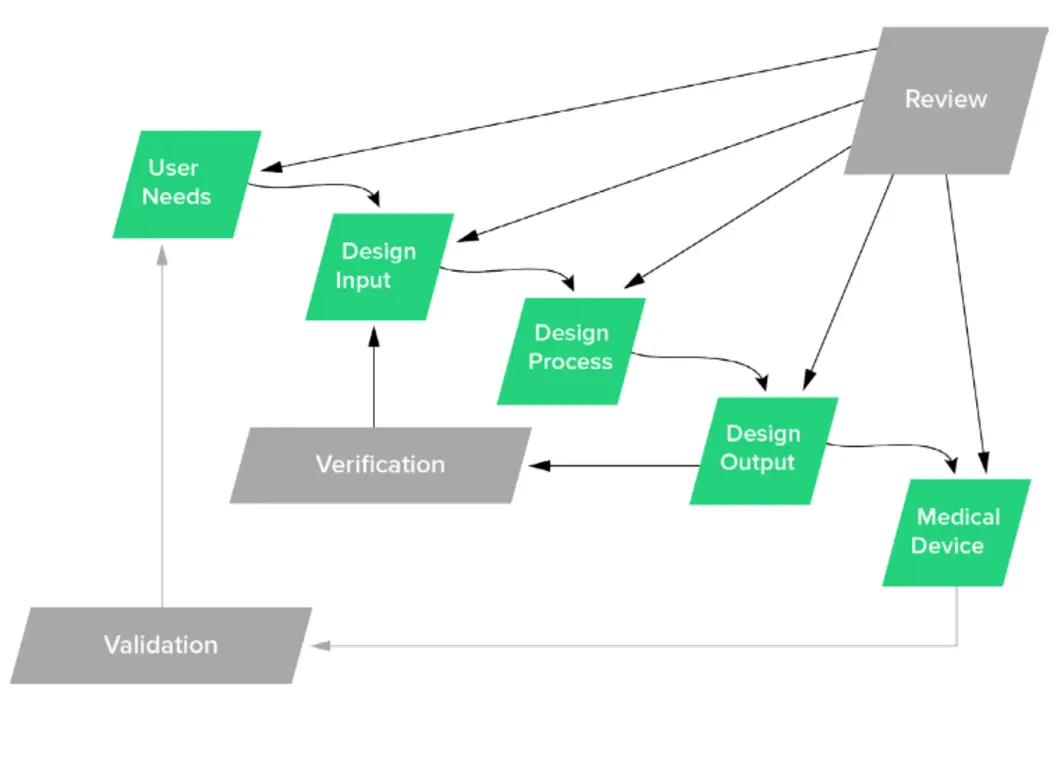
Verification asks whether the design output meets specified input requirements. Validation asks whether the final product meets user needs and intended uses under anticipated conditions. The distinction matters because a product can pass engineering tests yet still be difficult or unsafe for people to use.
A practical validation master plan should identify the evidence required for the complete system, not merely list constituent-part tests. Include the following areas.
Drug-device and biologic-device interaction
Assess interactions that could affect quality, performance, or use. Depending on the product, this may include extractables and leachables assessments, adsorption, aggregation, silicone oil effects, container closure integrity, particulate risk, dose delivery, needle or cannula performance, and stability throughout labeled storage and in-use conditions.
For an injector, evaluate the actual formulation at relevant extremes, not only a convenient surrogate. Viscosity, fill volume, temperature, air bubble behavior, and primary-container variation can influence delivery time and user feedback.
Device, packaging, and labeling performance
Verification may cover mechanical function, dose accuracy, activation force, lockout features, shipping and distribution effects, shelf-life performance, package opening, label durability, readability, and software functions where applicable.
Use production-representative articles for final validation whenever possible. If a fully final product is unavailable, document why the test article is sufficiently representative and identify every remaining difference and its potential effect on results.
Manufacturing readiness
Design validation is not a substitute for manufacturing process validation. The commercial process must repeatedly produce a product equivalent to the validated configuration.
Plan controls for incoming components, drug product fill, device assembly, labeling reconciliation, packaging, inspection, and release. Pay particular attention to interfaces where a pharmaceutical and device supply chain meet. A change in syringe barrel, lubricant level, stopper, assembly force, carton, or instructions can affect both performance and use.
FDA’s Quality Management System Regulation became effective in February 2026 and incorporates ISO 13485:2016 by reference for device quality management system requirements. Combination-product manufacturers should evaluate the applicable requirements under 21 CFR Part 4 alongside the drug, biologic, and device requirements relevant to their product and operating model.
Use risk management to connect engineering and human factors
The overall risk management file should address hazards from the combination product as a whole. Human factors work should be tied to that file rather than maintained as an isolated usability report.
A use-related risk analysis (URRA) focuses on use errors and foreseeable misuse. It considers how users interact with the product and what could happen if they omit or incorrectly perform a task. For combination products, the consequence may be overdose, underdose, delayed treatment, contamination, needlestick injury, or compromised therapy.
Begin with a task analysis covering the real use sequence:
- Receipt, storage, and inspection.
- Preparation and product checks.
- Device setup and dose selection where relevant.
- Administration technique.
- Confirmation of dose completion.
- Disposal, cleaning, maintenance, and storage between doses.
- Response to alarms, malfunctions, missed doses, and other foreseeable problems.
Identify combination product critical tasks: tasks that, if performed incorrectly or not performed, would or could cause harm to the patient or user, including compromised medical care. The definition is broader than simply identifying tasks associated with catastrophic injury. A task that leads to an ineffective dose may be critical even when the immediate effect is not severe.
For each critical task, document the foreseeable failure modes, causes, harm, existing controls, residual risk, and evidence needed to show that controls are adequate. Include drug-specific issues. A prolonged injection, for example, may change the likelihood that a user removes an autoinjector too soon.
Select human-factors studies for the decision you need to make
Human factors is most useful when it informs design decisions throughout development. It should not begin with a late-stage validation protocol.
Formative evaluations: improve the design
Formative studies are iterative evaluations of prototypes, early labeling, training concepts, packaging, and workflows. They help teams discover why users struggle and test design changes before the commercial configuration is fixed.
Recruit participants who represent intended users. A self-administering patient population may have limitations in dexterity, vision, cognition, or disease-specific function that healthy, technically confident participants do not represent. Include caregivers and healthcare professionals when they have distinct responsibilities.
Test realistic situations, including interruptions, low lighting where relevant, time pressure, storage transitions, and first-use learning. Formative evidence should directly influence the design history: record the finding, change considered, decision taken, and follow-up evaluation.
Human-factors validation: confirm the final user interface
A human-factors validation study evaluates whether the final finished combination product user interface supports safe and effective use by intended users, for intended uses, in intended environments. It focuses on critical tasks, labeling comprehension, training where applicable, and residual use-related risk.
For many products, a simulated-use validation study is appropriate. Simulation may use placebo, injection pads, manikins, representative rooms, or other methods that safely reproduce essential user interactions. The simulation must be realistic enough to evaluate the relevant tasks and hazards.
The study should reflect how users will actually learn to use the product. If training is required and reliably provided, evaluate the intended training process. If training is optional or cannot be assured, testing trained users alone may not represent commercial conditions. Training materials, trainer instructions, and the sequence of training are part of the user interface when they are relied upon as risk controls.
When actual-use human-factors validation may be needed
Actual-use validation is not automatically more persuasive than simulated use. It is considered when simulation cannot adequately represent important physical, environmental, or interaction conditions.
It is distinct from a clinical home-use study. A clinical study may provide important safety and effectiveness evidence, but it may not systematically observe user behavior or investigate task failures in the way a human-factors study does. Do not assume clinical exposure replaces human-factors validation without a clear rationale.
Before initiating a pivotal human-factors study, confirm that the device, packaging, labeling, and training are sufficiently final. Late changes to any of these elements can invalidate the relevance of study results. A change that affects critical tasks or introduces new use-related hazards may require additional assessment or another validation study.
Coordinate human factors with clinical development
Clinical and human-factors teams should share assumptions before clinical protocol finalization. At minimum, align on:
- The product configuration used in each study.
- Who administers the product and how they are trained.
- Whether dosing is supervised.
- How use errors, device complaints, and incomplete doses are captured.
- Which user-interface observations are feasible and which require a separate human-factors study.
- How protocol deviations may reveal product design or labeling issues.
Ideally, pivotal clinical studies use a user interface that is close to the version intended for market. If that is not possible, maintain a formal bridging assessment. Explain how differences in device design, label text, instructions, packaging, or training could affect use and what additional evidence closes the gap.
Keep validation alive after market launch
Combination-product validation does not end at approval or clearance. Complaint handling must preserve the link between product quality and user experience.
Set up complaint categories that distinguish, where possible, device malfunction, delivery failure, labeling confusion, training gap, storage issue, use error, and suspected drug-quality issue. Investigations should examine the returned device or packaging when available, relevant lot history, distribution conditions, and the user narrative without assuming that a reported event has a single cause.
Trend data should feed back into the risk management file, CAPA process, design-change assessment, and labeling review. A rise in incomplete-dose complaints, for example, may point to device performance variation, formulation changes, altered user behavior, unclear confirmation cues, or a combination of factors.
A workable governance model
The most effective programs give one accountable team ownership of the integrated product, while retaining specialist input from formulation, device engineering, quality, clinical, regulatory, manufacturing, packaging, human factors, and postmarket surveillance.
Use recurring cross-functional reviews to answer a small set of disciplined questions:
- What has changed in the intended user, use environment, product configuration, or training model?
- Which requirements, hazards, and critical tasks are affected?
- Does existing verification, validation, or clinical evidence still apply?
- Does the manufacturing process produce the same configuration that was evaluated?
- What needs to be discussed with the FDA lead center and other relevant reviewers?
A holistic approach does not mean testing every constituent part twice. It means planning the right evidence once, at the system level, and maintaining traceability as the product, process, and user interface evolve.