Materials, Manufacturing, Design & Development, Quality & Testing
PEEK versus PEKK Additive Manufacturing: Processing and Performance Tradeoffs
Updated
PEEK and PEKK are closely related high-performance thermoplastics, but they should not be treated as interchangeable printing materials. Both belong to the polyaryletherketone (PAEK) family and can offer strong mechanical performance, chemical resistance, and useful heat resistance. In additive manufacturing, however, their crystallization behavior creates different process windows, risks, and final part states.
For manufacturing teams, the central question is not simply which polymer has the stronger datasheet. It is whether the available printer, thermal controls, post-processing route, reinforcement, and validation plan can consistently produce the morphology and properties the component requires.
The short comparison
| Factor | PEEK | PEKK |
|---|---|---|
| Polymer family | PAEK | PAEK |
| General crystallization behavior | Relatively fast crystallization | Usually slower crystallization; strongly grade-dependent |
| FFF processing demand | Very high; tightly controlled thermal environment is commonly needed | High, but many grades offer a wider and more forgiving processing window |
| Warp and shrinkage risk | High if cooling is uneven | Often lower in slowly crystallizing or largely amorphous printed grades |
| Printed morphology | Can be semi-crystalline when thermal history supports it | May be printed largely amorphous or developed into a semi-crystalline state |
| Layer bonding challenge | High when deposited material cools or crystallizes too quickly | Often more manageable because material remains mobile for longer |
| Typical selection case | The application needs PEEK’s established performance and a controlled manufacturing route is available | Better dimensional control, layer bonding, or process robustness is needed without leaving the PAEK family |
These are broad tendencies, not fixed rules. PEKK is available in different grades and compositions, including grades designed to remain more amorphous during printing and grades capable of crystallizing under controlled conditions. A material supplier’s processing guide and data for the exact filament or pellet grade should therefore take priority over generic PEEK-versus-PEKK comparisons.
Why polymer structure matters in printing
PEEK means polyether ether ketone. PEKK means polyether ketone ketone. The extra ketone linkage in PEKK changes chain rigidity, thermal transitions, and, importantly for additive manufacturing, the way its molecular chains organize as the melt cools.
Both materials can form crystalline regions within an otherwise non-crystalline polymer matrix. This is why they are described as semi-crystalline polymers. Crystalline regions can improve resistance to heat, chemicals, and deformation, but they also create processing difficulties. As a deposited road cools and crystallizes, it shrinks. When adjacent regions cool at different rates, residual stress can build. In FFF parts, that can appear as curled corners, distortion, cracking, poor dimensional repeatability, or reduced bonding between layers.
PEEK generally crystallizes faster than commonly used PEKK grades. That behavior can help achieve a crystalline PEEK part when the print environment and cooling profile are well controlled. It also means PEEK is less tolerant of uncontrolled cooling. A part that is acceptable in a small test coupon can distort or show different crystallinity when its wall thickness, build height, infill, or orientation changes.
Many PEKK grades crystallize more slowly. This gives deposited roads more time for polymer chains to diffuse across an interface before the material stiffens. It can reduce the tendency toward rapid shrinkage during the build, improving print stability and interlayer fusion. It does not make PEKK a low-temperature or casual-printing material: it remains a high-performance polymer that needs suitable drying, extrusion capability, enclosure control, and disciplined process development.
Crystallinity is a process outcome, not just a material label
A frequent mistake is to call one printed part “PEEK” and another “PEKK” as if that alone predicts their performance. The polymer name matters, but final properties also depend on the part’s thermal history.
A printed PEEK part can have different crystallinity through its thickness if the surface cools faster than the core. A PEKK part may leave the printer predominantly amorphous, then gain crystallinity during a controlled thermal treatment. Two parts made from the same nominal filament can therefore differ in stiffness, heat resistance, dimensions, appearance, chemical resistance, and internal stress.
For production work, specify the required material state rather than only the polymer family. This may include:
- the approved feedstock grade and lot-control requirements;
- drying conditions and maximum permitted moisture exposure;
- nozzle, build plate, and chamber temperature ranges;
- the cooling or controlled-cooldown procedure;
- whether annealing is required;
- the target degree or range of crystallinity, where relevant;
- the test method used to confirm material state and part performance.
Differential scanning calorimetry can be used to examine melting and crystallization behavior, while dimensional inspection and mechanical testing show whether the complete manufacturing route is producing acceptable parts. For critical components, a visual check alone is not enough. An opaque or matte surface can suggest a more crystalline condition, while a translucent appearance can suggest a more amorphous condition, but color and appearance are not substitutes for validated material characterization.
PEEK processing: narrow thermal control and careful cooling
PEEK FFF normally requires equipment built for high-temperature polymers. The nozzle must reach an appropriate melt-processing range for the selected grade, and the build chamber needs enough thermal control to limit rapid cooling. A heated bed alone may not be sufficient, particularly for larger parts, high-aspect-ratio geometries, or parts with thick-to-thin transitions.
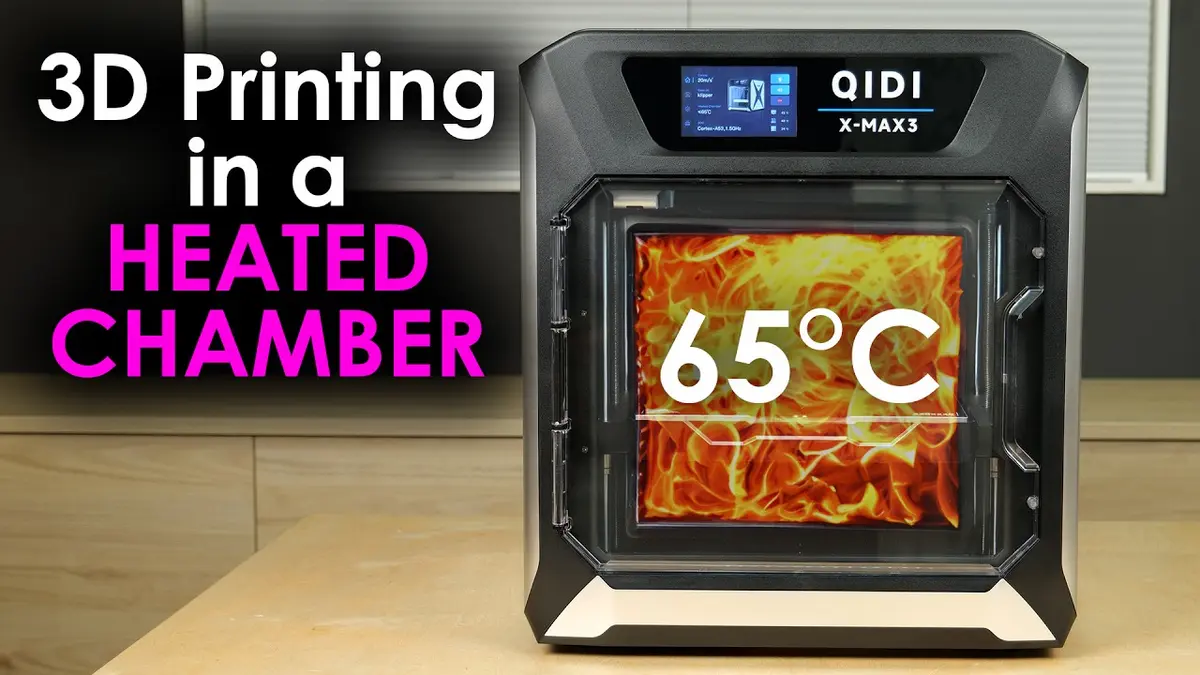
The practical objective is to keep newly deposited material warm enough for interlayer diffusion while reducing temperature gradients across the build. If the chamber is too cool, PEEK can contract sharply as it cools and crystallizes. The result may be lift-off from the build surface, warpage, or low Z-direction strength. If the thermal cycle is poorly managed, residual stress may also cause distortion after removal from the machine.
PEEK’s demanding process window does not mean it is unsuitable for additive manufacturing. It means the printing system, geometry, and post-processing plan must work together. A controlled heated chamber, stable airflow conditions, an appropriate build surface, and a managed cooldown are often part of the manufacturing process rather than optional refinements.
Annealing can be used when the intended part condition requires further crystallization or stress relaxation. However, it should not be added as a generic finishing step. Heat treatment can change dimensions, especially in asymmetric or constrained geometries. Validate the fixture approach, heating rate, soak conditions, cooldown, and dimensional acceptance criteria on representative parts.
PEKK processing: more latitude, but not one universal process
PEKK is often chosen because its slower crystallization can make FFF more manageable. A printed PEKK part may remain largely amorphous when cooling is relatively fast. This can improve dimensional stability during the build and often supports stronger layer-to-layer fusion than a rapidly crystallizing polymer processed under the same conditions.
That advantage is useful for complex geometries, large enclosures, fixtures, and components where distortion would compromise fit. It may also enable production on high-temperature machines that cannot deliver the chamber conditions preferred for crystalline PEEK.
The tradeoff is that an amorphous PEKK part is not automatically equivalent to a crystalline PEEK part. The final thermal and chemical performance depends on the grade and the resulting morphology. If the service environment requires a more crystalline PEKK condition, the team may need a validated in-process thermal cycle or post-print annealing route. This adds time and can alter dimensions, just as it can with PEEK.
PEKK also varies substantially by grade. Changes in the ratio and arrangement of monomers can affect melting behavior and crystallization rate. Avoid transferring settings from one PEKK filament supplier to another without requalification. “PEKK” is a family-level description, not a complete process specification.
Reinforced grades change both performance and risk
Carbon-fiber-filled PEEK and PEKK are widely used where added stiffness, lower thermal expansion, and improved dimensional stability are useful. The fibers can reduce warpage and make large parts easier to build. They can also improve stiffness in the preferred print directions.
But reinforcement introduces separate tradeoffs:
- Short fibers tend to increase anisotropy. Properties depend on bead direction, layer orientation, and fiber alignment during extrusion.
- Fiber-filled materials are usually less ductile than unfilled grades.
- Abrasive fibers increase nozzle wear. Hardened, wear-resistant extrusion components and nozzle inspection are needed.
- Surface finish, void content, and consolidation may differ from unfilled material.
- Fiber-filled grades can reduce the ability of polymer chains to diffuse across interfaces, so improved warp control should not be mistaken for guaranteed Z-strength.
For structural components, select orientation based on load paths, not only on print time or cosmetic appearance. Test coupons should be printed in the same orientation, build location, bead strategy, and thermal cycle used for the intended part. XY tensile values from a filament datasheet are not a reliable substitute for through-thickness or multi-axis performance data from the actual build process.
A practical selection approach
Choose PEEK when the design genuinely needs its established high-performance profile and the manufacturing system can maintain tight thermal control. This may be appropriate where long-term heat exposure, chemical exposure, mechanical loading, and a defined material state justify the added process complexity. The key requirement is a validated route that delivers repeatable crystallinity, dimensions, and interlayer properties.
Choose PEKK when the component needs PAEK-level performance but the manufacturing priority is a broader FFF process window, lower distortion risk, or improved layer fusion during the build. PEKK can be particularly attractive for complex shapes and parts that would be difficult to keep flat and stress-controlled in PEEK. Confirm whether the application accepts the as-printed amorphous state or requires a crystallized post-processed state.
For either material, begin selection with service requirements rather than the polymer name. Define the maximum continuous and short-term temperature, fluid or chemical exposure, applied loads, dimensional tolerances, expected sterilization or cleaning process where applicable, and expected part life. Then evaluate the material grade and printed condition against those requirements.
In medical-device development, neither PEEK nor PEKK should be assumed suitable for patient contact, implant use, sterilization, or regulatory submission simply because the polymer family has been used in other applications. Those decisions depend on the exact grade, additives, manufacturing route, cleaning, post-processing, and intended use.
Process controls worth documenting
A stable PAEK additive manufacturing process is built around traceable controls. At minimum, document feedstock identity, storage and drying, machine settings, chamber thermal history, build orientation, support strategy, post-processing, and inspection results. Monitor changes to nozzle condition, chamber calibration, and software versions because these can affect bead geometry and thermal exposure.
During development, use representative geometries rather than relying only on small tensile bars. Include wall-thickness changes, holes, long spans, corners, and interfaces that resemble the production component. Measure distortion after printing and again after annealing or other thermal treatment. If mechanical performance matters, test in directions that represent the actual load case, especially through the layer stack.
The main PEEK versus PEKK additive manufacturing tradeoff is therefore straightforward: PEEK can reward strict thermal-process control with a highly capable semi-crystalline part, while PEKK often gives teams more freedom to achieve stable builds and strong interfaces. The better choice is the one whose grade, morphology, and validated process match the component’s real service conditions.