Materials, Design & Development, Quality & Testing
Implantable Polymer Degradation Mechanisms and How They Lead to Device Failure
Updated
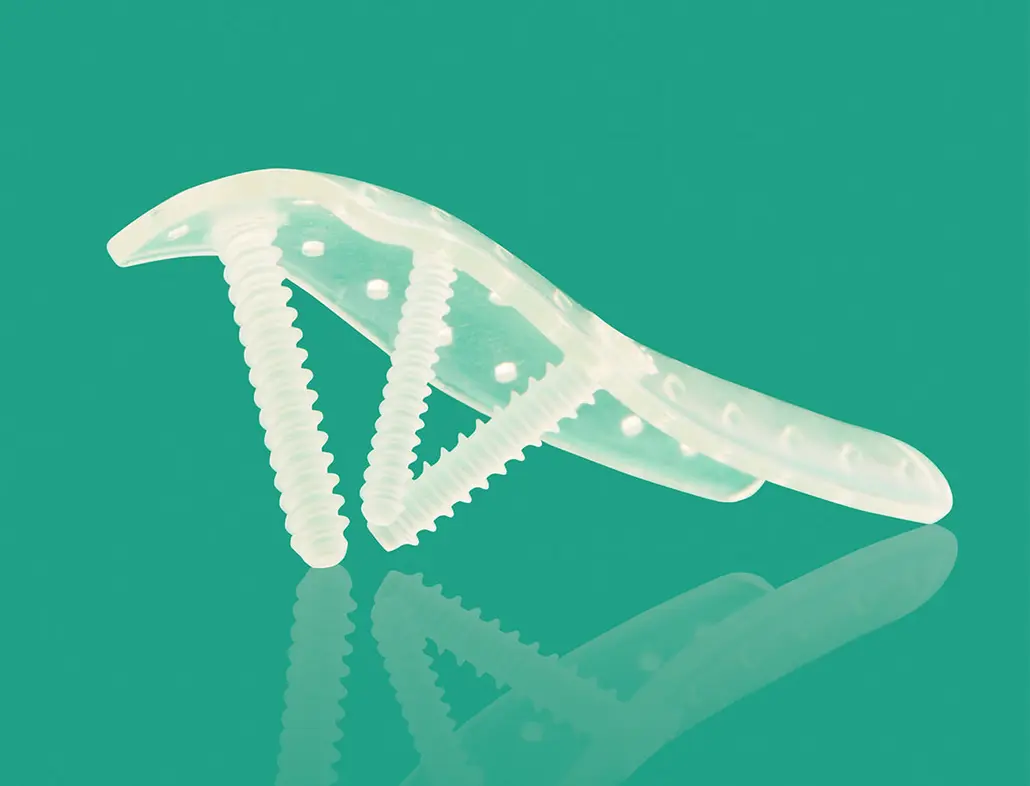
A polymer implant does not fail only when it disappears or visibly breaks. It can become clinically unsuitable much earlier because molecular weight falls, stiffness changes, cracks initiate, a coating separates, or released products alter the local environment. Predicting those changes requires more than selecting a polymer with a published resorption time.
The practical task is to connect the intended function of the finished device to the degradation mechanisms likely to operate in its anatomical environment. Material chemistry matters, but so do part geometry, processing history, sterilization, mechanical loading, interfaces, and the way degradation products leave the device.
Start with the implant’s required function over time
A useful service-life prediction begins with a time-based functional requirement, not a generic statement that a material is durable or biodegradable. Define what the device must do immediately after implantation, during healing or drug delivery, and after its intended function ends.
For a fixation component, the key question may be: how much load-bearing capability must remain at each stage of tissue healing? For a drug-eluting implant, it may be: can the matrix maintain a predictable release profile without an unacceptable initial burst, dose interruption, or late release of retained drug? For an insulation layer or coating on a permanent implant, the requirement may be continued electrical isolation and adhesion under motion and fluid exposure.
Mechanical properties do not necessarily decline together. A polymer can lose molecular weight while showing little early mass loss. It may retain apparent stiffness yet lose toughness, elongation at break, fatigue resistance, or resistance to crack growth. Therefore, mass loss alone is not a service-life metric.
A practical requirement set should identify:
- The function to be retained: fixation, barrier performance, insulation, controlled release, structural support, or another device-specific role.
- The relevant failure mode: fracture, creep, crack growth, delamination, loss of apposition, leakage, embolization risk, debris generation, or release-profile drift.
- The minimum acceptable property at each relevant time point.
- The expected anatomical environment, including fluid exposure, loading, motion, tissue contact, inflammation, and flow.
- The acceptable fate of degradation products, particles, and any residual implant material.
The main implantable polymer degradation mechanisms
Several mechanisms may occur at the same time. The dominant mechanism can also shift as the implant structure changes.
Hydrolysis: water-driven chain scission
Hydrolysis is particularly important for many resorbable polyesters, including materials based on lactide, glycolide, caprolactone, and related copolymers. Water diffuses into the polymer and cleaves susceptible bonds in the chain backbone. The first measurable change is often a reduction in molecular weight rather than a visible loss of device mass.
As chains become shorter, the polymer can lose strength or ductility. Eventually, low-molecular-weight fragments become mobile enough to diffuse out, and measurable mass loss accelerates. In a bulk-eroding implant, water penetrates much of the component before substantial material is removed. This can produce a misleadingly intact-looking part with a weakened interior.
The local chemistry can further complicate the profile. Acidic degradation products may accumulate in thicker or less-permeable regions, potentially accelerating internal hydrolysis. How readily products diffuse away depends on device dimensions, porosity, fluid access, and surrounding tissue.
Oxidation and reactive oxygen species
Oxidative degradation results from reactions involving oxygen-derived reactive species. These species can be present in the biological environment, especially around an activated inflammatory response. Certain polymer structures are more vulnerable to oxidative attack than others.
Oxidation can cause chain scission, surface embrittlement, chemical changes, and altered surface morphology. It is especially relevant when a device may experience chronic inflammation, repeated tissue motion, particulate debris, or interfaces with other materials that influence the local environment.
A simple saline soak may reveal hydrolysis but miss an oxidation-driven pathway. That does not mean every study requires an aggressive oxidative challenge. It means the test plan should explain whether oxidation is a credible failure contributor for the specific device, implant location, and intended duration.
Mechanical loading, environmental stress cracking, and fatigue
Mechanical stress does not need to break a pristine polymer immediately to matter. Repeated loading, sustained strain, notches, molded-in residual stress, and stress concentrations can create conditions for crazing, microcracking, creep, or fatigue damage.
Water absorption can make this worse in susceptible amorphous polymers. Absorbed water may plasticize the material, alter intermolecular interactions, and reduce resistance to stress cracking. A crack that begins at a sharp corner, suture hole, weld line, attachment feature, or coating defect can grow under cyclic loading even when the bulk material appears acceptable.
Testing an unloaded coupon may therefore be inadequate for a device subjected to bending, tension, compression, pulsation, articulation, or repeated deployment forces. The test should apply loading that represents the expected failure mechanism rather than simply adding load as a generic stressor.
Wear, abrasion, and third-body debris
Articulating, sliding, or repeatedly contacting components can produce polymer debris through wear and abrasion. Surface damage can also open pathways for fluid ingress, initiate cracks, and accelerate release of embedded additives or drug.
Debris is not merely a mechanical cleanliness issue. Particle size, quantity, composition, and persistence can affect tissue response. If the implant operates near metallic or ceramic components, debris from more than one material may be present, and particles can alter the local contact conditions. This can promote further wear, sometimes described as third-body wear.
Interface failure and delamination
Multilayer implants introduce a separate class of risk. A polymer coating may detach from a metal substrate, a drug reservoir layer may separate from a rate-controlling membrane, or dissimilar polymers may delaminate at a bonded interface.
Water can penetrate an interface through an edge, pinhole, crack, or adhesion defect. Thermal expansion mismatch, swelling, residual stress, cyclic strain, and chemical change at the interface may then drive separation. A coating can remain chemically stable while the device still fails because adhesion declines below the required level.
Crystallinity, morphology, and processing history change the profile
The same nominal polymer chemistry can perform differently after extrusion, injection molding, machining, annealing, solvent processing, additive manufacturing, or sterilization. These processes affect molecular orientation, residual stress, crystallinity, porosity, and molecular-weight distribution.
Crystalline domains can restrict water transport and slow attack in some regions. Amorphous regions are often more accessible to water and may degrade earlier. However, degradation itself can change morphology: shorter chains may rearrange, crystallinity may increase or decrease depending on the system, and the remaining material can become more brittle.
This is why resin data alone cannot establish the behavior of a finished implant. The relevant specimen is the final, sterilized, packaged device or a representative fabricated form with the same material history.
Control and characterize variables that can shift degradation behavior:
- Resin molecular weight and molecular-weight distribution.
- Copolymer ratio, residual monomer, catalyst residues, and additives.
- Thermal history, orientation, and degree of crystallinity.
- Wall thickness, surface area, porosity, and internal voids.
- Joining methods, coatings, and interfaces.
- Moisture exposure before processing and during storage.
- Sterilization and package atmosphere.
For hydrolytically sensitive resins, incoming moisture and elevated processing temperatures deserve particular attention. Moisture present during melt processing can reduce molecular weight before the device is implanted, changing both baseline properties and the subsequent degradation curve.
Link molecular changes to implant-level failure modes
The most useful development models do not stop at chemical degradation rate. They map a chain of events from molecular change to device consequence.
| Molecular or structural change | Potential device-level consequence | Useful measurements |
|---|---|---|
| Molecular-weight reduction | Strength, toughness, or fatigue resistance declines before mass loss | SEC or viscosity-based molar-mass analysis; tensile, flexural, compression, or fatigue testing |
| Water uptake and plasticization | Dimensional change, reduced stiffness, creep, stress cracking | Mass uptake, dimensional inspection, mechanical testing, microscopy |
| Increased porosity or cracking | Fluid ingress, leakage, accelerated hydrolysis, particle release | Microscopy, micro-CT where appropriate, permeability or leak testing |
| Surface oxidation | Embrittlement, roughening, altered friction or adhesion | Surface chemistry methods, microscopy, wear testing |
| Interface degradation | Coating lift, delamination, loss of barrier or release control | Adhesion testing, cross-sections, cyclic loading, visual and microscopic inspection |
| Degradation-product accumulation | Local pH shift, altered drug release, tissue-response concerns | Medium pH trending, degradation-product analysis, release testing |
The table is not a fixed test menu. It is a way to prevent an incomplete claim such as “the implant retained mass” from standing in for the functional evidence the device actually needs.
Drug release and degradation must be evaluated together
For drug-eluting implants, degradation is often part of the release mechanism, but it is rarely the only one. Drug can leave by diffusion through the matrix, diffusion through pores or membranes, polymer erosion, swelling, or a combination of these processes.
A polymer that absorbs water can change drug mobility before appreciable erosion occurs. Early water ingress may contribute to burst release. Later chain scission, pore formation, cracking, or coating defects may cause a second acceleration in release. Conversely, changes in crystallinity or a poorly connected pore structure can slow release and leave drug trapped in the implant.
Drug loading can also change polymer behavior. It may alter crystallinity, create phase separation, modify water uptake, or affect mechanical properties. Processing conditions that preserve drug potency may not produce the same morphology as conditions optimized for an unloaded polymer component.
A development program should therefore track drug release alongside relevant material changes. At a minimum, assess whether changes in molecular weight, mass, dimensions, morphology, and mechanical integrity correspond to changes in the release curve. The intended product profile should define allowable burst, maintenance period, total release, and residual drug rather than treating a smooth in vitro curve as sufficient evidence on its own.
Build degradation testing around the likely failure pathway
In vitro testing is indispensable for screening materials and comparing design iterations, but it is a model, not a direct substitute for in vivo performance. A relevant study starts by selecting conditions that reproduce the drivers of the expected failure mode.
For hydrolytically degradable surgical implants, ASTM F1635 addresses in vitro degradation testing of hydrolytically degradable polymer resins and fabricated forms. It describes tracking changes such as mass, molar mass, and mechanical properties, with mechanically loaded evaluation considered when loading is relevant in use. It should be applied with attention to its scope and to the actual device configuration.
Use the finished device whenever possible
Test articles should represent final dimensions, processing, sterilization, packaging, and any clinically relevant assembly. Coupons remain useful for material screening and analytical work, but they can miss geometry effects, edge-driven ingress, stress concentrations, and interfaces.
Sample enough time points to see the transition
The important event is often the transition from early molecular-weight loss to loss of functional properties. Space time points more closely around expected changes in strength, release rate, cracking, or mass loss. Do not rely only on day-zero and end-of-study data.
Measure chemistry, structure, and function
A defensible degradation profile typically combines:
- Molecular weight or molar-mass change.
- Water uptake, mass change, and dimensions.
- Mechanical properties tied to the use case.
- Visual inspection and microscopy for cracks, pores, erosion, and delamination.
- Thermal or morphological characterization when crystallinity changes are important.
- Medium pH and degradation-product monitoring where local chemistry is relevant.
- Drug assay and release testing for combination products.
Include loading and flow when they matter
A static soak cannot reveal every clinically relevant mechanism. Consider sustained load, cyclic loading, flexing, articulation, or fluid flow when these conditions could affect crack growth, wear, erosion, release, or retention of degradation products. The objective is not to create the most severe test, but to reproduce or bound a credible failure mechanism.
Be cautious with accelerated aging
Elevated temperature can shorten hydrolytic studies and support comparative decisions, but it is only useful if the dominant mechanism remains the same. A higher temperature may change crystallinity, diffusion behavior, phase structure, or the relative importance of competing reactions. Arrhenius-based extrapolation should therefore be supported by evidence that the accelerated condition has not created a different degradation pathway.
A practical development sequence
A structured sequence reduces the risk of discovering late that the device fails by a mechanism absent from early test plans.
- Define required function and allowable failure modes over the intended implant duration.
- Identify plausible hydrolytic, oxidative, mechanical, wear, and interface-related mechanisms.
- Characterize the final fabricated device, not only the resin specification.
- Run screening studies to establish molecular-weight, water-uptake, morphology, and mechanical-property trends.
- Add representative loading, flow, articulation, or release testing where the use case requires it.
- Examine failed and aged specimens to confirm whether observed failure matches the predicted mechanism.
- Use the results to revise material selection, geometry, processing window, coating design, packaging, or sterilization strategy.
The central principle is simple: predict failure by following the full path from polymer chemistry to functional loss. A credible service-life assessment shows when the implant changes, why it changes, and whether it still performs its required function at each stage of that change.