Materials, Design & Development, Quality & Testing, Regulation & Standards
Medical Adhesive Selection for Skin and Medical Devices: Balancing Safety, Bond Strength, and Sterilization
Updated

Medical adhesive selection for skin and medical devices is not a simple choice between a strong and a gentle material. An adhesive may hold a wearable sensor securely but cause skin stripping at removal. A structural adhesive may survive repeated steam cycles but be too rigid for a flexible assembly. A formulation described as medical grade may still be unsuitable for the finished device, its contact duration, or its sterilization route.
Start with the actual adhesive function. Is it securing a device to skin, joining internal components, sealing a fluid path, fixing a needle in a hub, or retaining a label? Each function creates a different combination of patient-contact, mechanical, process, and environmental requirements.
Begin with the adhesive location and intended contact
The first decision is not chemistry. It is where the cured adhesive sits in the finished product and what it can contact during use.
For a skin-contacting adhesive, define:
- The contact type: intact skin, damaged skin, mucosal tissue, or another body-contact category.
- Expected wear time: minutes, hours, several days, or repeated applications.
- Patient population: including whether fragile, compromised, neonatal, or otherwise sensitive skin is foreseeable.
- Area of application: flat skin, a joint, a high-moisture location, or a region exposed to friction from clothing.
- Removal expectation: single-use removal, repositioning, or repeated application and removal.
For an internal assembly adhesive, define whether the adhesive is directly exposed to the patient or whether extractables could reach a fluid path, tissue, or medication. An adhesive used outside a patient-contacting enclosure may require a different assessment from one that seals a blood-contacting component.
The device, not an adhesive datasheet alone, is the unit that must be evaluated. Supplier data can help narrow candidates, but it does not establish that an adhesive is suitable in the final geometry, cure state, processing history, and intended use.
Separate skin attachment from structural assembly
Many device programs use the word “adhesive” for two very different jobs. Keeping them separate prevents poor early choices.
| Adhesive role | Typical priority | Common adhesive families | Main risk if selected poorly |
|---|---|---|---|
| Device-to-skin attachment | Gentle removal, conformability, wear time, moisture handling | Acrylic, silicone, hydrocolloid, polyurethane pressure-sensitive adhesives | Irritation, skin injury, lift-off during wear |
| Structural component bonding | Shear strength, sealing, durability, process repeatability | Epoxy, UV-curable adhesive, polyurethane, cyanoacrylate | Cracking, leakage, bond separation, incomplete cure |
| Temporary manufacturing hold | Clean removal, short dwell, process compatibility | Removable PSA tapes | Residue, contamination, part damage |
| Label or identification attachment | Permanent adhesion, legibility after cleaning and sterilization | Acrylic or silicone PSAs | Peeling, unreadable traceability information |
A skin-contact PSA is generally not a replacement for a rigid structural adhesive. Conversely, a high-strength epoxy is not a suitable substitute for a skin attachment system merely because it is described as biocompatible in a particular test configuration.
Choose chemistry based on the failure mode you need to avoid
Pressure-sensitive adhesives for skin and wearables
Pressure-sensitive adhesives bond under applied pressure without a separate chemical curing step. They are widely used in dressings, electrodes, wearable sensors, securement products, and transdermal systems.
The important trade-off is between tack, peel adhesion, shear holding power, and removability. A highly aggressive adhesive may resist lifting at the edges but can increase pain, residue, or skin trauma during removal. An exceptionally gentle adhesive may remove cleanly but fail under sweat, movement, device weight, or long wear duration.
Acrylic PSAs are often selected where longer wear, stronger adhesion, and resistance to moisture or environmental exposure are needed. Silicone PSAs are often considered when gentle removal, repositionability, and reduced trauma to fragile skin matter most. Neither category is automatically appropriate: formulation, coat weight, backing, device mass, and geometry all affect the result.
The complete skin-contact stack matters. A breathable backing and suitable moisture-vapor transmission can be as important as the adhesive itself. Occlusion, trapped moisture, edge lift, and repeated stripping can all contribute to skin problems even if the adhesive passes a basic material screen.
Cyanoacrylates for rapid assembly or tissue applications
Cyanoacrylates cure rapidly in the presence of moisture and can provide fast handling strength. In device assembly, they are useful where a thin bond line and fast production cycle are needed. They can bond many plastics and metals, but their rigid nature can be a limitation in joints that flex, experience impact, or join materials with very different thermal expansion.
For external wound closure, medical formulations and their intended clinical use are distinct from general-purpose cyanoacrylate products. Do not assume a device-assembly cyanoacrylate is appropriate for tissue contact, or that a tissue adhesive is appropriate for structural assembly.
For reusable devices, repeated steam sterilization is a particular concern. A cyanoacrylate bond that performs adequately after one manufacturing sterilization exposure may not retain performance after many autoclave cycles.
Epoxies, UV-curable adhesives, polyurethanes, and silicones
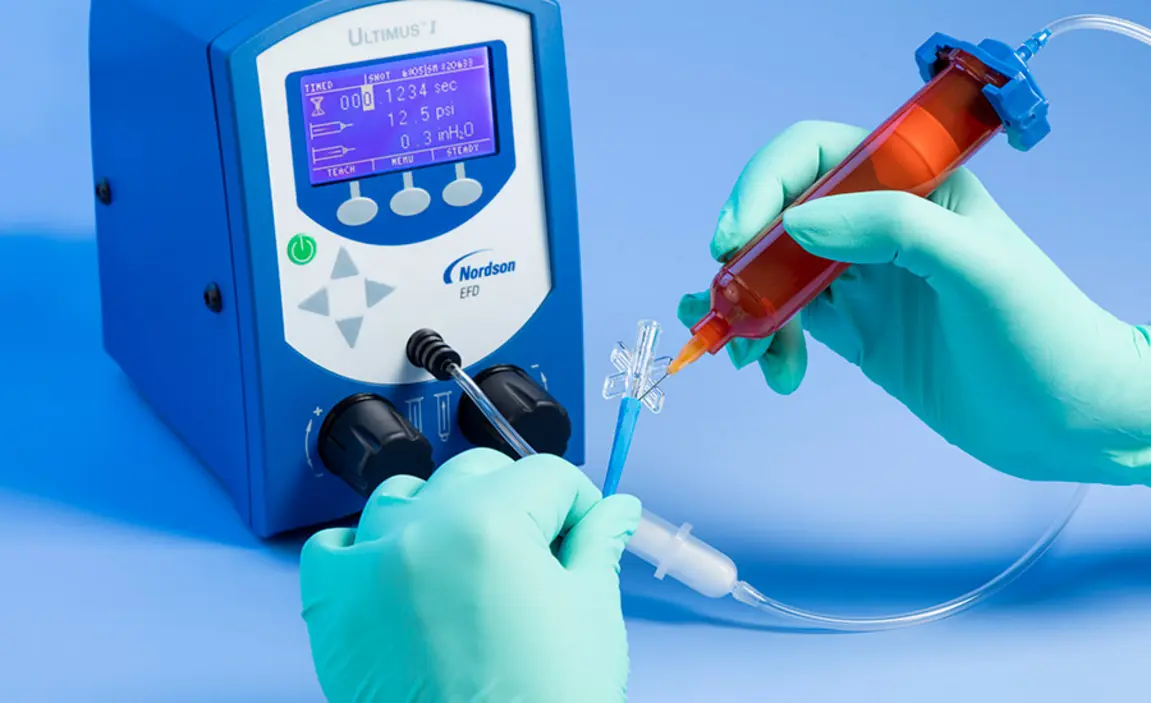
Epoxies are commonly used for rigid, durable bonds, encapsulation, and needle-to-hub assembly. They can provide strong chemical and thermal resistance, but cure conditions, brittleness, viscosity, and heat generation must fit the parts and production process.
UV-curable adhesives enable rapid processing where light can reach the bond line. They can work well on transparent or translucent components, but shadowed regions require a secondary cure mechanism or another process. Verify cure depth and the effect of component geometry rather than assuming exposure at the edge proves full cure.
Polyurethane adhesives can provide flexibility and useful bonding across different substrates. Their cure mechanism and sensitivity to moisture need careful process control.
Silicone adhesives and sealants are valuable where flexibility, thermal stability, or adhesion to difficult substrates is needed. Their low surface energy can also make later over-bonding, printing, or coating difficult without appropriate surface preparation.
Understand adhesion failure and cohesion failure
When a bonded joint fails, the appearance of the failure can identify the next design step.
Adhesion failure occurs at the interface between adhesive and substrate. The adhesive separates cleanly from one surface. Common causes include inadequate surface energy, contamination, insufficient pressure, incompatible substrates, poor wet-out, or a surface treatment that was not maintained through storage and assembly.
Cohesion failure occurs within the adhesive layer. Adhesive residue remains on both surfaces, or the adhesive tears internally. This can indicate insufficient cohesive strength for the applied load, excessive temperature, incomplete cure, an unsuitable bond-line thickness, or aging and sterilization damage.
A third possibility is substrate failure, where the adhesive bond remains intact but the backing, foam, plastic component, or skin fails first. On skin, this is clearly not a success: a very strong bond can still be unsafe if removal damages the stratum corneum.
Test the joint under the stress it will actually see:
- Peel for tapes, dressings, labels, and skin-worn devices.
- Shear for device weight, hanging tubing, and overlapping structural joints.
- Tensile for direct pull-apart loads.
- Cleavage for stiff parts loaded at an opening edge.
- Cyclic flexing for wearables, catheter securement, and flexible housings.
Do not rely on lap-shear values alone for a PSA used on skin. A skin-mounted device normally fails through edge lifting and peel, not a clean tensile pull.
Match the adhesive to substrates and surface preparation
Adhesives bond to real manufactured surfaces, not material names on a drawing. A polymer’s grade, mold release, additives, texture, printing inks, surface treatment, and time since treatment can all change bonding behavior.
Low-surface-energy polymers such as polyethylene and polypropylene are especially challenging. They may require a specifically formulated adhesive, primer, plasma treatment, corona treatment, flame treatment, or a mechanical redesign that increases bonding area. A promising result on a freshly treated prototype may disappear if treatment levels decay before production bonding.
For every candidate, document:
- Substrate grade and supplier.
- Surface finish and molding or machining condition.
- Cleaning method and allowable residue.
- Surface treatment, treatment level, and maximum time before bonding.
- Adhesive lot, mixing ratio where relevant, and storage condition.
- Dispense pattern, bond-line thickness, pressure, cure profile, and fixture time.
This process information is not administrative overhead. It is part of the adhesive system. A sound formulation can deliver inconsistent performance if the line applies too little material, mixes a two-part system incorrectly, or exposes only part of a UV bond line.

Treat sterilization as a full-system exposure
Sterilization compatibility cannot be inferred from chemistry alone. The relevant question is whether the final device, including adhesive, substrates, packaging, labels, and functional components, remains safe and performs as intended after the specified validated sterilization process.
Common exposures create different risks:
- Ethylene oxide (EtO): Often compatible with many adhesive systems, but residual management, aeration, packaging, and material interactions remain relevant.
- Gamma or electron-beam radiation: Can cause chain scission, crosslinking, discoloration, embrittlement, or changes in tack and peel behavior depending on the material.
- Steam autoclaving: Combines elevated temperature, moisture, and pressure. It is demanding for many adhesive joints and is especially important for reusable devices.
- Vaporized hydrogen peroxide and liquid chemical sterilants: May affect adhesives, coatings, labels, and sensitive electronics differently from heat or radiation.
A disposable product sterilized once during manufacture has a different requirement from a reusable instrument expected to tolerate many reprocessing cycles. Define the number of cycles, dwell conditions, drying steps, and cleaning chemicals before selecting the adhesive.
After sterilization, inspect more than bond strength. Check discoloration, cracking, creep, tack, residue, seal integrity, leakage, optical clarity, electrical performance, and changes in skin-contact behavior. Aging before and after sterilization may also reveal effects that immediate testing misses.
Build biocompatibility into the selection plan
Terms such as “medical grade,” “skin safe,” and “biocompatible” are useful starting points, not universal approvals. Biocompatibility evaluation depends on the device’s nature, contact type, contact duration, and materials in the finished configuration.
For adhesives with direct or indirect patient contact, involve biocompatibility and regulatory specialists early. The evaluation may consider the cured adhesive, potential residual monomers, initiators, plasticizers, processing aids, degradation products, and any migration pathway through the device.
ISO 10993 is commonly used as a framework for biological evaluation of medical devices. Cytotoxicity screening is frequently part of the evidence package, but it is not a substitute for evaluating the final device against the relevant contact category and duration. Supplier test reports should be reviewed for the tested material, cure method, test article, and applicable conditions rather than treated as blanket clearance.
For skin-worn devices, usability work is also important. Capture practical outcomes such as application force, edge lift, residue, discomfort on removal, visible erythema, and performance after sweat and movement. This evidence helps distinguish a bond that is strong in a laboratory fixture from one that is acceptable in use.
Use a staged selection and verification process
A disciplined selection plan reduces late redesigns.
1. Write measurable requirements
Convert broad requests such as “gentle but secure” into measurable targets. Include wear duration, device mass, peel and shear loads, allowable edge lift, removal force range where appropriate, service temperature, chemical exposure, sterilization route, and expected reprocessing cycles.
2. Screen a small number of adhesive systems
Choose candidates based on contact classification, substrate compatibility, processing constraints, and sterilization route. Avoid selecting from a datasheet strength ranking alone.
3. Test representative constructions
Use production-intent substrates, bond areas, cure conditions, packaging, and sterilization exposure. For skin attachment, test the complete adhesive, backing, device, and application geometry.
4. Investigate failures before changing chemistry
If a joint fails, first determine whether the failure is adhesive, cohesive, or in the substrate. Review surface cleanliness, treatment, adhesive coverage, cure, bond-line thickness, and fixture conditions. Changing adhesive chemistry without identifying the failure mechanism can create a second problem.
5. Lock process controls with the selected material
Define incoming inspection, storage limits, thaw time if applicable, mix and dispense controls, cure verification, surface-preparation controls, and post-sterilization inspection. A validated adhesive choice must be paired with a repeatable manufacturing process.
A practical decision rule
For skin attachment, start by selecting the least aggressive PSA that maintains secure wear through the stated duration and conditions. Increase adhesion through device geometry, larger bond area, flexible construction, and load distribution before simply choosing a more aggressive adhesive.
For structural device assembly, start with the sterilization route, the substrates, and the joint stresses. Then select a chemistry that can cure reliably within the actual manufacturing window and retain the required properties after exposure. Confirm biocompatibility based on the finished device and its intended contact, not the product name on an adhesive label.
The strongest bond is not automatically the safest or most durable choice. Successful medical adhesive selection is a controlled balance: enough adhesion for the intended load, enough cohesion for the service environment, appropriate biological evaluation for the final device, and verified resistance to the sterilization and reprocessing conditions the product will face.