Quality & Testing, Manufacturing, Regulation & Standards
How to Set Medical Device Bioburden Sampling and Limits for Sterile Products
Updated
Bioburden limits should not be chosen from a generic table and applied unchanged to every sterile medical device. A defensible program links the sample to the part of the process it represents, uses a recovery method proven suitable for the device, and sets limits that support the validated sterilization process.
For terminally sterilized devices, the central question is usually: does the microbial population entering sterilization remain consistent with the population used to validate the process? A useful sampling plan answers that question before it becomes a sterility assurance problem.
Start with the intended use of the data
Bioburden is the viable microbial population present on or in a product before sterilization. It is commonly reported as colony-forming units (CFU) per device, per sample item portion, per gram, or per milliliter.
The data may serve several different purposes:
- establishing or substantiating a radiation sterilization dose;
- supporting validation and routine control of an ethylene oxide (EO), steam, vaporized hydrogen peroxide, or other terminal sterilization process;
- monitoring routine manufacturing cleanliness;
- assessing a process change, supplier change, or new manufacturing location;
- investigating an atypical count, sterilization deviation, or sterility test failure.
These purposes affect the plan. A routine trend-monitoring plan is not necessarily sufficient for a radiation dose-setting study. Conversely, an extensive dose-setting sample set should not be copied blindly into routine production if the applicable sterilization standard and process risk assessment support a different ongoing schedule.
ISO 11737-1 provides the core framework for determining bioburden on medical devices. The applicable sterilization standard then determines how the results are used. For example, radiation sterilization programs use bioburden as an input to dose establishment and dose audits under the ISO 11137 series. EO process validation and routine control are addressed under ISO 11135.
Map the process before selecting sample points
A final packaged device is often the primary bioburden sample because it represents what enters terminal sterilization. However, final-product testing alone may not reveal where a rising trend begins. Build a simple process map first.
Include incoming materials, cleaning or washing, drying, assembly, fluid-path processing, inspection, packaging, storage before sterilization, and transfer to the sterilizer. Mark points where the product is exposed to people, water, air, equipment, or difficult-to-clean fixtures.
Then select sampling points based on the decisions each point can support.
| Sampling location | What it can show | When it is useful |
|---|---|---|
| Incoming component or raw material | Supplier-related microbial contribution | New suppliers, natural materials, water-exposed components, recurring incoming variation |
| Post-cleaning or post-washing component | Effectiveness of cleaning and drying | Devices with a washing step or reusable manufacturing fixtures |
| In-process assembly | Contamination introduced during a specific operation | Complex assembly, manual handling, long hold times, open processing |
| Final packaged product before sterilization | Microbial condition of the released product entering sterilization | Routine monitoring and sterilization validation support |
| Fluid path or internal lumen | Contamination in areas not represented by an external rinse | Catheters, tubing sets, connectors, reservoirs, and other internal pathways |
Do not create a long list of in-process samples simply because each step could be tested. Each sample point should have a purpose, an owner, a defined response to an excursion, and a practical way to collect it without adding contamination.
For many stable device lines, final packaged product monitoring plus targeted environmental and process controls is appropriate. More in-process sampling may be justified during development, after a deviation, or where the final test has limited ability to isolate the source of contamination.
Choose samples that represent real production variation
A sample plan should cover the sources of variation that could change bioburden. Selecting several units adjacent to each other at the end of one shift may be convenient, but it does not represent the whole process.
Consider variation in:
- manufacturing shift and operator group;
- manufacturing day and seasonal conditions;
- device size, configuration, and packaging format;
- component and material lot;
- assembly line or work cell;
- cleanroom or controlled-area location;
- equipment, cleaning cycle, and maintenance state;
- elapsed time between manufacture, packaging, and sterilization.
For a product family, determine whether one product can represent others. A small, simple device is not automatically a valid representative for a larger device with porous materials, a long lumen, more handling steps, or a higher surface area. The representative product should be selected using a documented worst-case rationale, not commercial volume alone.
Whole device, product portion, or pooled sample?
Testing a whole device is generally preferred when the device fits the extraction method and the cost is reasonable. It avoids uncertainty about whether the tested portion represents the rest of the product.
A defined sample item portion may be appropriate for very large products, provided it includes the areas most likely to retain contamination and the result is clearly normalized. Examples include a defined length of tubing, a specified surface area, or a complete fluid path.
Pooling can reduce laboratory workload, but it loses unit-to-unit information. A pooled result may show that a group has elevated bioburden without identifying whether one device caused the result. Use pooling only when the method is suitable, the pooling factor is documented, and the loss of resolution is acceptable for the intended decision.
Validate the recovery method before setting limits
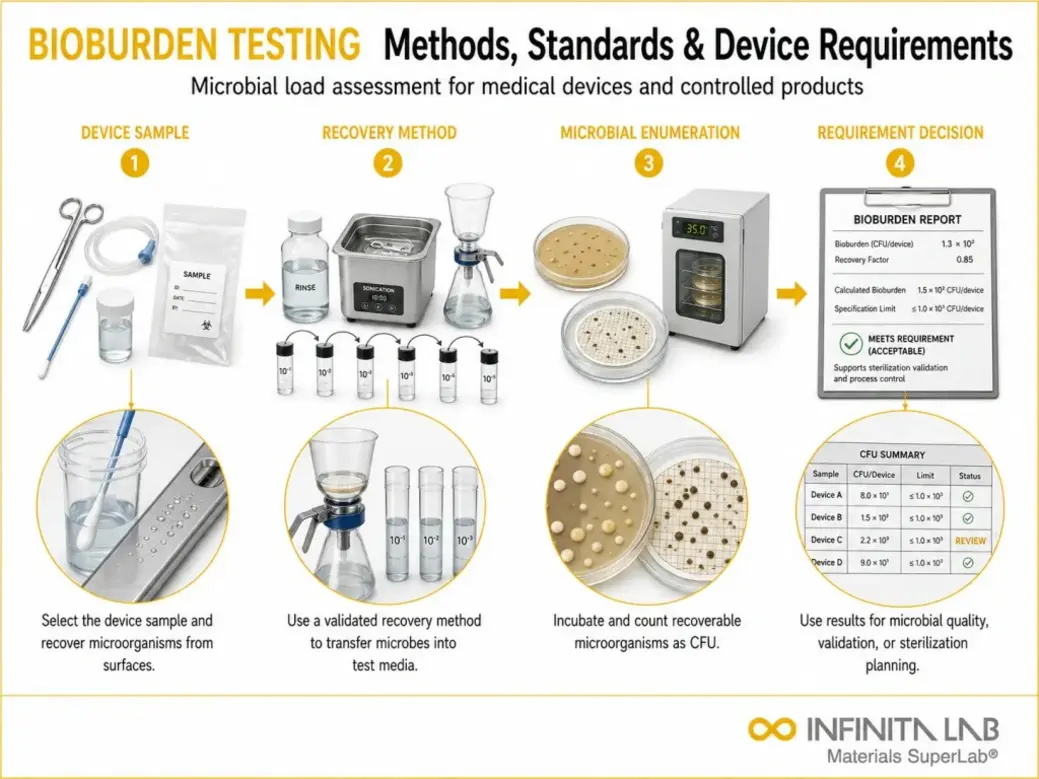
A low result is useful only if the method can recover organisms from the device. Device design often determines the appropriate extraction approach.
- Immersion and agitation may suit small, accessible devices.
- Fluid-path flushing is often needed for lumened devices.
- Sonication can improve recovery from complex surfaces, but its settings must not damage the device or unacceptably reduce organism recovery.
- Swabbing is generally a localized method and may be suitable for defined surfaces, but it is rarely a complete substitute for extracting a whole complex device.
- Membrane filtration can provide sensitivity when an extract can be filtered without clogging.
- Pour plating or another suitable enumeration approach may be needed for extracts containing particulate matter or materials that interfere with filtration.
Method suitability should consider extraction fluid, agitation conditions, extraction time, neutralizers or surfactants where needed, culture conditions, sample handling, and countability. The recovery efficiency and any correction approach must be defined before routine data are trended against limits.
Do not change the extraction method, recovery factor, sample portion, or culture conditions midway through trend analysis without assessing the impact. A sudden shift in results may reflect the new method rather than a real manufacturing change.
Set sample size and frequency from risk and data
There is no universal number of devices per lot or one universal testing frequency for medical device bioburden. The number should be supported by the purpose of the test, the sterilization method, manufacturing consistency, product risk, and the applicable standard.
During initial validation, qualification of a new line, or after a significant process change, use sampling that deliberately captures variability across lots, shifts, operators, component lots, and normal operating conditions. This establishes the baseline needed to understand the process.
For routine monitoring, start with a frequency that can detect change early. More frequent testing is normally warranted when:
- production is new or increasing rapidly;
- the product has a complex internal geometry or absorbent materials;
- process steps are open or heavily manual;
- there has been a recent cleaning, facility, supplier, or packaging change;
- historical counts are variable or trending upward;
- the validated sterilization dose or cycle has a narrow process margin.
A stable, mature line may support reduced frequency, but the justification should use sufficient historical data and should be reviewed after changes. Routine frequency must also meet any specific requirements associated with the sterilization validation method. For radiation sterilization, dose audits and their associated bioburden determinations follow the requirements of the applicable ISO 11137 method; they are not replaced by a general internal monitoring schedule.
A useful procedure states both the normal frequency and event-driven testing triggers. Event-driven samples may follow a cleanroom excursion, water-system issue, extended production hold, equipment repair, damaged packaging, supplier change, or atypical environmental monitoring result.
Set three levels: baseline, alert, and action
A single pass/fail limit is often too blunt for routine control. Use three related controls instead.
Baseline or normal operating range
This describes the established process performance. It should be based on adequately representative historical data generated by the same validated method. Record both individual device results and lot summaries. Mean values alone can hide a few heavily contaminated units.
Alert level
An alert level is an early signal. It should prompt review and increased attention, not automatic rejection of product. Typical actions include confirming the calculation, reviewing test controls, checking concurrent environmental and process data, examining recent changes, and increasing sampling if justified.
Action level
An action level indicates a result that requires formal investigation and a documented product-impact assessment. It is not necessarily the same as the maximum count used during sterilization validation. The action level should account for the sterilization process capability, product and process history, organism type where relevant, and the quality system response available to control risk.
Avoid setting limits solely from a mean plus a simple statistical multiplier when the data set is small, highly skewed, or includes many zero counts. Bioburden data commonly show substantial unit-to-unit variation. A microbiologist or statistician can help select a method that reflects the distribution and the decision risk.
TAMC and TYMC: use the terms in the correct context
TAMC means total aerobic microbial count. TYMC means total yeast and mold count. These terms are most commonly used in pharmacopeial microbial enumeration testing for non-sterile pharmaceutical products and materials.
For a terminally sterilized medical device, ISO 11737-1 bioburden testing is usually reported as total recovered viable microorganisms per device or other defined unit. The test may recover bacteria, yeasts, and molds, but a medical-device bioburden result should not be relabeled as TAMC or TYMC unless the method, media, incubation conditions, and product requirements actually support those pharmacopeial categories.
This distinction matters particularly for combination products, drug-coated devices, prefilled systems, and manufacturing processes involving pharmaceutical solutions. A product may need both a medical-device bioburden program and pharmaceutical microbial enumeration controls, but the acceptance criteria and sample preparation should remain clear.
If separate TAMC and TYMC testing is required, do not assume that splitting one small sample between two media provides the same sensitivity as testing the full stated quantity for each test. The sample volume, test portion, dilution, and calculation must be justified in the method.
Investigate a missed sample or nonconforming result
A missed bioburden sample should not be treated as an administrative gap. It removes evidence that the process was under control for the affected lot or time period. The required response depends on the product, sterilization method, available supporting data, and reason the sample was missed.
For a nonconforming result, begin by protecting the integrity of the investigation.
- Confirm the result. Review sample identity, chain of custody, calculations, media and control performance, incubation conditions, dilution factors, recovery correction, and any laboratory deviation. Do not invalidate a result merely because it is inconvenient.
- Assess the product impact. Identify affected lots, manufacturing dates, sterilization loads, product configurations, and any related material or environmental events.
- Review the process timeline. Check cleaning records, maintenance, water or compressed-gas data, room conditions, operator practices, production holds, component lots, packaging operations, and transport to sterilization.
- Characterize organisms when useful. Identification can help distinguish common environmental flora from unusual organisms, spores, repeated isolates, or organisms associated with water or a particular source. The value of identification depends on the investigation; it is not automatically needed for every low count.
- Use additional samples carefully. Retesting retained samples or increasing future sampling may help define scope, but additional passing results do not erase an original valid result.
- Document disposition and corrective action. The record should explain the batch decision, risk assessment, root cause or most probable cause, corrective actions, and effectiveness checks.
A product-impact assessment should consider both the number and nature of recovered organisms, the validated sterilization process, the relationship to the validated bioburden population, and evidence of broader process control. A count above an internal alert or action level does not automatically prove sterilization failure, but it does require a reasoned assessment rather than an assumption that terminal sterilization resolves every upstream problem.
What a defensible plan should contain
A practical bioburden sampling plan should be short enough for operators and laboratories to follow, but detailed enough to withstand review. At minimum, document:
- the product family and rationale for any representative or worst-case device;
- sampling locations and the risk each location addresses;
- lot, shift, operator, and configuration selection rules;
- number of units, test portions, pooling rules, and sample timing;
- sterile collection, labeling, transport, and maximum hold conditions;
- validated extraction and enumeration method, including recovery treatment;
- reporting units and calculation rules;
- baseline, alert, and action levels with their rationale;
- routine frequency and event-driven testing triggers;
- organism identification criteria;
- investigation, product-disposition, and escalation requirements;
- change-control triggers requiring plan reassessment.
The strongest medical device bioburden sampling and limits program is not the one with the most samples or the lowest numerical limit. It is the one that reliably detects meaningful change, represents the device and its manufacturing process, and remains connected to the sterilization validation it is meant to support.