Quality & Testing, Regulation & Standards, Design & Development
Avoiding Medical Device EMC Testing Mistakes That Delay 510(k) Clearance
Updated

Passing an emissions test is not the same as demonstrating electromagnetic compatibility for a 510(k). FDA reviewers need to see that the medical device does not create unacceptable interference and that it remains safe when exposed to foreseeable electromagnetic disturbances in its intended environment.
Many medical device EMC testing mistakes begin before the laboratory booking: the intended environment is too broadly described, essential performance is undefined, or the submitted configuration does not match the marketed system. A test report may look complete while still leaving the reviewer unable to determine what was tested, what was excluded, and whether the evidence applies to the device described in the 510(k).
Start with the FDA EMC submission framework
FDA’s 2022 EMC guidance applies to electrically powered medical devices and to devices with functions or sensors implemented through electrical or electronic circuitry. It asks manufacturers to provide EMC information that is connected to the actual device, its risks, intended use, and use environments.
For many medical electrical devices, IEC 60601-1-2 is the principal EMC consensus standard used in the submission strategy. However, applying a recognized standard does not remove the need for device-specific reasoning. The manufacturer still needs to establish appropriate pass/fail criteria, represent real-world use, address gaps or deviations, and explain the relationship between EMC results and the risk management file.
Before finalizing the test plan, confirm the FDA recognition status and applicable edition of every standard proposed for the submission. Recognition can be partial, can include limitations, and can change over time. Particular standards, other IEC 60601 collateral standards, product-specific standards, or FDA guidance may also affect the program.
The recurring gaps in EMC test plans
Treating emissions as the whole EMC program
Emissions testing shows whether the device releases electromagnetic disturbances within applicable limits. It does not show that the device can tolerate disturbances from its environment.
Immunity testing is where performance weaknesses frequently appear. Depending on the applicable standard, device type, power source, environment, and risk analysis, the plan may need to cover phenomena such as:
- Electrostatic discharge (ESD)
- Radiated RF electromagnetic fields
- Conducted RF disturbances
- Electrical fast transients or bursts
- Surge immunity
- Voltage dips, short interruptions, and voltage variations
- Power-frequency magnetic fields
A common failure is using an old project plan or a non-medical EMC standard without checking whether it covers the device and FDA’s current expectations. Another is testing only the normal operating mode while leaving out charging, data transfer, battery operation, standby, high-power output, or other modes that change susceptibility.
The practical fix is a requirements-to-test matrix. List each applicable immunity phenomenon, required level, device mode, configuration, acceptance criterion, result, deviation, and report location. Review the matrix with systems engineering, risk management, software, regulatory, and the test laboratory before formal testing begins.
Selecting the wrong use environment
A device used in a hospital is not automatically limited to the professional healthcare facility environment. Likewise, a device labeled for home use may be used in residences, transport, workplaces, public spaces, and other non-professional locations. These distinctions affect the EMC environment and may affect test levels and supporting standards.
FDA separates intended use settings into professional healthcare facility, home healthcare, and special environments. A home-use device tested only to professional healthcare conditions can raise questions because the home setting may include uncontrolled RF sources, less controlled power quality, and different user behavior.
Special environments require explicit consideration. Examples may include locations near high-powered medical equipment, MRI-related areas, heavy industrial facilities, aircraft, or military installations. Do not claim compatibility with such settings through broad marketing language unless the EMC evaluation and risk controls support it.
The intended environment should be consistent across the indications for use, device description, risk analysis, EMC test plan, test report, instructions for use, and marketing claims. A mismatch between any of these documents can create avoidable review questions.
Testing a convenient configuration rather than the worst credible one
EMC results only apply to the tested configuration and to configurations justified by engineering analysis. The smallest setup on a laboratory bench is often not the most susceptible or highest-emitting arrangement.
A representative system may include the base unit, patient-connected components, sensors, external displays, docking stations, chargers, data cables, reusable accessories, and approved third-party support equipment. Cable type, length, routing, shielding, and termination can materially affect emissions and immunity.
Use a configuration rationale that answers these questions:
| Test-plan question | What the file should show |
|---|---|
| What is the marketed system? | A current list of models, accessories, software, cables, power supplies, and interfaces. |
| Which configuration is worst case? | Technical reasoning based on cable length, loads, operating state, enclosure condition, power mode, and interfaces. |
| What was physically tested? | Photographs, setup drawings, cable details, device serial or model identification, and software version. |
| What was excluded? | A documented justification, including why the exclusion does not reduce the relevance of the result. |
Do not shorten a cable merely to make the test arrangement easier unless the shortened cable is the actual marketed maximum or the deviation is justified. Do not substitute a lab power supply for the marketed adapter without evaluating the effect. The same applies to accessories that were not available at the time of testing: either test them later or establish, document, and maintain a defensible equivalence assessment.
Leaving wireless functions inactive or out of scope
Bluetooth, Wi-Fi, cellular modules, RFID, inductive links, and proprietary radios can affect both the EMC configuration and the broader regulatory evidence package. A device may behave differently while transmitting, receiving, pairing, uploading data, or recovering from a dropped connection.
The EMC plan should identify every wireless technology, frequency function, antenna arrangement, operating state, and accessory that forms part of the medical device system. For emissions and immunity testing, exercise wireless functions when doing so represents a credible worst case.
Wireless coexistence is related to, but not identical with, EMC. EMC testing may not show whether the device maintains its intended wireless function in the presence of other common emitters operating in the same or nearby bands. Where loss, delay, corruption, or interruption of wireless communication could affect safety or clinical performance, assess that risk separately and determine whether coexistence testing or other evidence is needed.
Define essential performance before immunity testing
One of the most consequential medical device EMC testing mistakes is writing generic acceptance criteria after test results are available. Statements such as “no malfunction observed” are rarely enough unless they are tied to defined device behavior and risk.
Essential performance concerns performance whose absence or degradation would create unacceptable risk. It must come from the device’s intended use, hazard analysis, risk controls, and clinical function—not from a laboratory preference.
For a monitoring device, relevant criteria may include alarm generation, measurement accuracy within an established specification, display integrity, data recording, and recovery after disturbance. For a therapy device, they may include delivery parameters, timing, unintended output prevention, alarms, and safe transition to a defined state. The exact criteria are device-specific.
Write the criteria in observable and measurable terms before testing. Define both what must remain functional during exposure and what recovery is permitted after exposure. A transient display flicker may be acceptable for one device, while a brief missed alarm or loss of therapy control is not.
Separate continuous and transient disturbances where appropriate. A device may be expected to maintain full function during continuous RF exposure, but a short transient event may justify controlled recovery if the risk analysis supports it and the device returns to a safe state without unacceptable loss of function.
Include basic safety, not only intended clinical output
Immunity criteria should also cover basic safety functions. Check for unintended resets, loss of protective alarms, incorrect displayed values, corrupted settings, unexpected output, loss of communication, failure to restart safely, and misleading status indicators.
This matters especially when a disturbance does not cause an obvious shutdown. A device can appear to keep running while displaying an incorrect value, suppressing an alarm, or silently disconnecting from a required accessory.
Build traceability from risk management to the EMC report
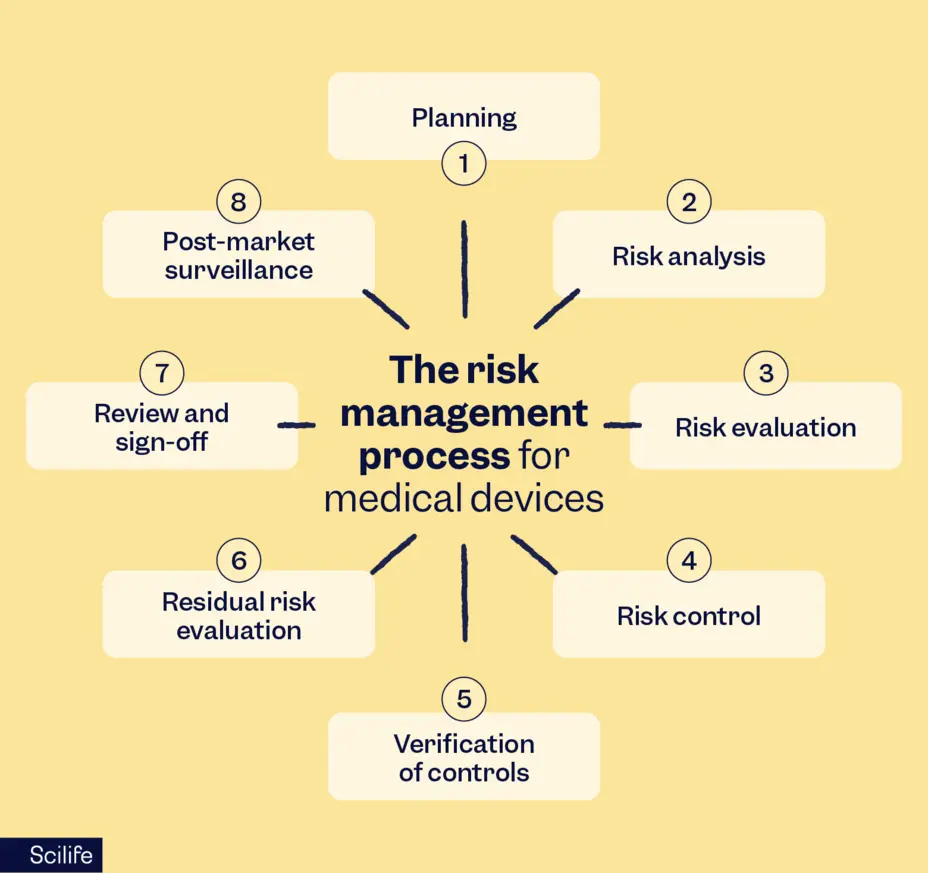
FDA review becomes more efficient when the logic is easy to follow. The risk analysis should identify reasonably foreseeable electromagnetic disturbances and describe the harms that could follow from malfunction, disruption, or performance degradation. The EMC test plan then turns those risks into configurations, test levels, operating modes, and acceptance criteria.
The final report should preserve that traceability. It should clearly identify:
- The device model, hardware revision, and software or firmware version tested
- All accessories, cables, chargers, and support equipment used
- Power-source states, including mains and battery operation where applicable
- Functions and modes exercised during each test
- The intended use environment and applied test levels
- Essential-performance and basic-safety acceptance criteria
- Results, observed behavior, recovery actions, and final disposition
- Allowances, deviations, exclusions, and their rationale
- Changes made after testing and the assessment of their EMC impact
A simple cross-reference table can prevent confusion. Link each EMC hazard or hazardous situation to the relevant test, criterion, result, risk-control verification, and labeling control. Do not rely on an informal explanation held only by the engineering team.
Manage changes after the EMC report is issued
An EMC report can become stale quickly. Changes to enclosure materials, printed circuit board layout, grounding, power supplies, cable assemblies, battery packs, wireless modules, software timing, accessory designs, or filtering components may affect EMC behavior.
Establish a documented change-assessment process. For each proposed modification, determine whether it could affect emissions, immunity, essential performance during immunity testing, or the validity of the tested configuration. The answer may support no additional testing, focused retesting, or a full reassessment, but it should be based on engineering and risk rationale rather than assumptions.
The submission device description, labeling, bill of materials, and test report should describe the same released configuration. If commercial hardware has changed since testing, resolve that discrepancy before submitting the 510(k).
Review labeling as part of the EMC evidence
EMC-related labeling is not a substitute for adequate design or testing, but it can communicate necessary conditions of use. Depending on the device and the evidence, labeling may need to address specified cables and accessories, separation distances from RF transmitters, prohibited environments, power-source limitations, or actions to take following interference.
Keep labeling claims narrow and supported. A statement that the device is suitable for home use should align with the evaluated home healthcare environment. A statement that an accessory is compatible should align with the tested or justified system configuration.
A pre-submission EMC readiness check
Before locking the 510(k), ask the project team the following:
- Does the EMC plan use currently appropriate FDA-recognized standards or clearly justify alternatives?
- Are all applicable emissions and immunity tests included for the intended environment?
- Are professional, home, and special-environment claims consistent across every document?
- Is essential performance defined before testing and tied to unacceptable risk?
- Was the device tested as a system in justified worst-case configurations, with marketed cables and accessories?
- Were mains, battery, charging, communication, alarm, and other relevant operating modes evaluated?
- Are wireless functions included, and has wireless coexistence risk been considered separately where needed?
- Are deviations, exclusions, failures, recoveries, and post-test design changes documented and assessed?
- Do the report, risk file, device description, and labeling all describe the same product?
An EMC package is strongest when it tells one consistent story: this is the device, these are the foreseeable electromagnetic conditions of use, these functions must remain safe, and this evidence shows that they do. That consistency is what reduces follow-up questions, retesting, and preventable 510(k) delay.