Materials, Quality & Testing, Regulation & Standards
How to Verify Medical-Grade Titanium Claims: Grades, Standards, and Traceability
Updated
“Medical grade” is a useful starting term, but it is not a material specification. A titanium supplier can use the phrase for commercially pure titanium, standard Ti-6Al-4V, Ti-6Al-4V ELI, or stock supplied to a general industrial specification.
For an implantable device, the question is not whether the material sounds medical. It is whether the delivered lot matches the alloy, product form, condition, standard, inspection requirements, and traceability defined in the device manufacturer’s purchasing specification.
A defensible purchase record links a physical bar, plate, wire, or forging to a specific melt or heat; shows the actual test results for that lot; and demonstrates that the material meets the applicable implant material standard. A generic certificate of compliance, a website statement, or an ISO certificate alone does not do this.
Start with the intended use and the exact material callout
Before requesting certificates, define what the component needs to do. Material selection should account for load, fatigue exposure, corrosion environment, device geometry, manufacturing route, surface treatment, and duration and type of body contact. The final material choice belongs in the device design and risk-management process, not in a supplier’s marketing description.
For many titanium implant applications, the starting point is one of these families:
| Material family | Common designation | Typical implant material standard | Practical distinction |
|---|---|---|---|
| Commercially pure titanium | CP titanium Grades 1–4 | ASTM F67; ISO 5832-2 | Unalloyed titanium with strength increasing from Grade 1 to Grade 4; often selected where corrosion resistance, formability, or moderate strength is needed. |
| Standard Ti-6Al-4V | Grade 5, Ti-6Al-4V | ASTM F1472; ISO 5832-3 | Higher-strength alpha-beta alloy. It is not automatically equivalent to ELI material. |
| Ti-6Al-4V ELI | Grade 23, Ti-6Al-4V ELI | ASTM F136 | Extra-low-interstitial form of Ti-6Al-4V, commonly specified where high strength, ductility, and damage tolerance are important. |
The standard named in the purchase order matters as much as the grade name. For example, Grade 23 supplied to a general industrial bar specification is not automatically material supplied to ASTM F136 for surgical implant applications. The chemistry may appear similar, but the applicable specification, testing, certification, and acceptance requirements may differ.
Likewise, a supplier calling material “Grade 5” does not establish that it meets ASTM F1472. A correct claim needs both the alloy identity and the governing material specification.
Commercially pure titanium: ASTM F67 and ISO 5832-2
Commercially pure, or CP, titanium is not one single purity level. ASTM F67 covers four grades of unalloyed titanium intended for surgical implant applications. Grades 1 through 4 differ primarily in controlled interstitial and impurity limits, particularly oxygen and iron. As grade number increases, strength generally rises and ductility decreases.
This distinction is important because “CP titanium” on a quotation is incomplete. A buyer should know whether the requirement is Grade 1, 2, 3, or 4, as well as the requested product form and condition.
ASTM F67 is the common US implant material specification for unalloyed titanium. ISO 5832-2 is the related ISO specification for unalloyed titanium for surgical implants. They should not be treated as interchangeable merely because both concern CP titanium. Review the exact edition cited in the device documentation and confirm that the mill certificate explicitly states every required standard.
For a purchase order, a usable material callout may include:
- alloy and grade, such as unalloyed titanium Grade 4;
- applicable standard and revision, such as ASTM F67;
- required form, such as bar, wire, sheet, plate, or forging stock;
- dimensional tolerances and surface condition;
- annealed or other required delivery condition;
- certificate type and required test data;
- lot, heat, or melt traceability requirements.
Ti-6Al-4V and Ti-6Al-4V ELI are not the same purchase requirement
Ti-6Al-4V contains nominally 6% aluminium and 4% vanadium. It is widely used where more strength is required than CP titanium can provide. However, the phrase “Ti-6Al-4V” still leaves a major question unanswered: standard interstitial material or extra-low-interstitial material?
Interstitial elements such as oxygen, nitrogen, carbon, and hydrogen affect titanium properties. ELI means extra low interstitials. Ti-6Al-4V ELI has tighter limits on specified interstitial and impurity elements than standard Ti-6Al-4V. This generally supports improved ductility and fracture toughness compared with the standard-interstitial alloy, while retaining high strength.
ASTM F136 specifies wrought Ti-6Al-4V ELI alloy for surgical implant applications. ASTM F1472 addresses wrought Ti-6Al-4V alloy for surgical implant applications, without the ELI designation. Both are implant-focused specifications, but they are not substitutes unless the device manufacturer has evaluated and approved an equivalence.
The ISO 5832 series also includes titanium alloy specifications. ISO 5832-3 addresses wrought Ti-6Al-4V alloy for surgical implants. Buyers should verify the current edition and the actual chemical limits on the certificate rather than assume that an ISO 5832-3 reference means ELI material. If Ti-6Al-4V ELI is required, the purchasing specification should say so explicitly and identify the required standard, commonly ASTM F136.
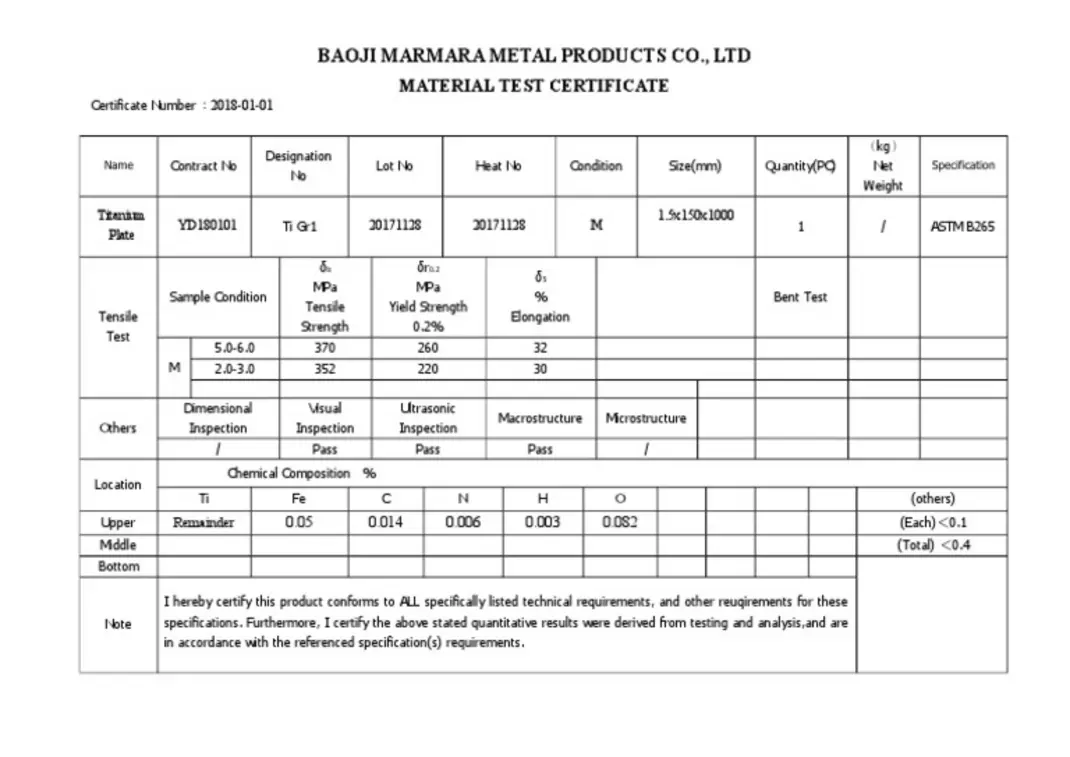
What a useful mill test certificate must show
A mill test certificate, often called an MTC, material test report, or certificate of analysis, should identify the actual lot shipped. Its value comes from lot-specific results, not from a general statement that the supplier’s products meet a standard.
At minimum, review the following fields before accepting titanium sold as implant grade.
1. Clear material identity
The certificate should state the alloy and grade in unambiguous terms. Examples include:
- unalloyed titanium Grade 2 to ASTM F67;
- unalloyed titanium Grade 4 to ASTM F67;
- Ti-6Al-4V ELI to ASTM F136;
- Ti-6Al-4V to ASTM F1472.
Avoid certificates that state only “titanium,” “medical titanium,” “implant material,” or “Grade 5 ELI.” These terms may be commercially useful, but they do not provide a complete acceptance basis.
2. The applicable standard and revision
The document should identify the standard against which the lot was evaluated. Where a device specification requires a particular revision or supplementary requirement, that should appear on the purchase order and be reflected in the supplier documentation.
Do not accept a broad claim such as “ASTM compliant.” Ask: compliant with which ASTM standard, for which product form, and based on which lot-specific tests?
3. Heat, melt, or lot number
The certificate must include a unique traceability identifier. That number should match the marking on the material, package label, traveler, or other controlled identification used by the supplier.
For cut lengths, small wire coils, or machined blanks where direct marking is impractical, the receiving and inventory process must preserve the link through controlled labels and records. Once material from different heats is mixed without documented segregation, the original mill traceability may be lost.
4. Actual chemistry results
The certificate should report the measured chemistry for the lot, not merely the specification limits. For Ti-6Al-4V and Ti-6Al-4V ELI, verify aluminium and vanadium as well as controlled elements such as oxygen, nitrogen, carbon, hydrogen, and iron. For CP titanium, check the elements and limits applicable to the specific F67 grade.
A chemistry result within a broad industrial grade range does not prove conformance to an implant specification. Compare each reported value with the requirement in the cited standard and the device manufacturer’s internal material specification.
5. Mechanical test results and condition
Mechanical properties depend on material form, size, processing condition, and test direction. The certificate should report applicable tensile properties, typically including tensile strength, yield strength, and elongation. It should also identify the supplied condition, such as annealed, and the product form.
Do not compare a result from sheet to a bar requirement without checking the applicable standard tables. Dimensional form and processing route can affect the acceptance requirements.
Certification is layered, not a single document
Three different concepts are often confused during sourcing.
Material standard conformance means a defined lot of material meets the stated alloy, chemistry, mechanical, and other requirements of a material specification.
Quality management system certification means an organization’s quality system has been audited against a standard such as ISO 13485 or ISO 9001. ISO 13485 can be relevant when evaluating a supplier serving medical-device manufacturers, but it does not certify every titanium lot as implant grade.
Finished-device compliance concerns the complete device. Material conformity is only one input. The finished component may also require process validation, cleaning validation, surface characterization, packaging controls, biocompatibility evaluation, sterilization validation, and regulatory documentation appropriate to its intended use.
A supplier certificate cannot establish that a finished implant is safe, sterile, biocompatible, or cleared for a particular market. It can establish evidence about the raw material lot, if the document and traceability are adequate.
Check the physical material against the paperwork
Receiving inspection should do more than file the certificate. Establish a documented check between the shipment and the purchase order.
Confirm:
- supplier name and approved-supplier status;
- purchase order number and material specification revision;
- material form, dimensions, quantity, and condition;
- heat or lot number on the certificate and shipment label;
- correct alloy, grade, and implant material standard;
- chemistry and mechanical results against acceptance criteria;
- certificate approval, issue date, and document integrity;
- absence of unauthorized substitutions, mixed lots, or relabeling.
For critical material, the device manufacturer may also require independent chemical verification, dimensional inspection, ultrasonic examination, metallographic review, or additional mechanical testing. These are not universal requirements. They should be selected through the supplier-control and risk-management process based on the device, material form, sourcing history, and potential failure modes.
Traceability must survive downstream manufacturing
A correct certificate at goods receipt is not enough if traceability disappears during production. The manufacturer should be able to connect each finished device or controlled production batch back to the incoming material lot used.
This typically requires controlled identification through cutting, machining, cleaning, surface treatment, and assembly. The exact method depends on the manufacturing process. Some organizations retain lot identity on containers and travelers; others use electronic material control in an enterprise or manufacturing execution system.
The key requirement is practical: when a nonconformance, complaint, or field investigation occurs, the manufacturer must be able to determine which incoming titanium lot entered the affected product batch and which other products used that lot.
Traceability also affects rework and scrap handling. Material removed from a labeled bar and placed in an unmarked bin can no longer be assumed to retain its original status. Establish rules for remnant identification, segregation, return to stock, and disposal.
Red flags in medical-grade titanium claims
The following situations deserve clarification before material is released for production:
- The quotation says “implant grade” but names no ASTM, ISO, EN, or internal material specification.
- The certificate identifies Grade 23 but cites only a general industrial specification when ASTM F136 was required.
- The supplier provides a generic certificate of compliance with no chemistry, mechanical data, or heat number.
- The heat number on the certificate does not match the packaging or physical identification.
- One certificate is supplied for several shipments or lots without a documented relationship between them.
- The supplier offers an ISO 13485 certificate in place of lot-specific material evidence.
- The certificate reports limits only, rather than actual test results.
- Material has been cut, repackaged, or redistributed and the chain back to the original mill heat is unclear.
- A material substitution is proposed because the alloy name appears similar.
None of these points automatically prove that the material is unacceptable. They do mean the buyer lacks the evidence needed to accept it confidently until the discrepancy is resolved.
A practical verification checklist
Before approving titanium for an implantable component, confirm all of the following:
- Device requirement defined: The design documentation identifies the exact alloy, grade, product form, condition, and performance needs.
- Correct implant standard named: CP titanium is specified to the relevant F67 or ISO 5832-2 requirement; Ti-6Al-4V and ELI material are distinguished and tied to the required standard.
- Purchase order is specific: It includes standard, revision where needed, form, size, tolerances, condition, and documentation requirements.
- Lot-specific MTC received: The certificate includes the supplier, alloy, standard, heat or lot number, actual chemistry, and applicable mechanical test results.
- Certificate matches shipment: Labels, markings, quantities, form, and heat or lot identifiers agree with the received material.
- Results reviewed: Chemistry and mechanical values meet the applicable standard and internal acceptance criteria.
- Supplier controls assessed: Supplier approval considers quality-system capability, change notification, certificate control, and traceability practices.
- Additional inspection justified: Any independent testing or supplementary inspection is defined by risk, not added casually or omitted by assumption.
- Internal traceability maintained: The incoming heat or lot remains linked to production records and finished-device batches.
- Changes controlled: A new mill, melt route, product form, condition, alloy grade, or standard revision is evaluated through formal change control.
The useful definition of medical-grade titanium is therefore evidence-based: material delivered to the required implant specification, with lot-specific test data and an unbroken traceability path. That standard of verification protects procurement, manufacturing, and regulatory teams from treating a marketing label as proof of material suitability.