Medical Devices, Design & Development, Manufacturing, Quality & Testing
Key Challenges and Best Practices in Microfluidic Device Reliability and Manufacturing
Updated

Introduction
Microfluidic devices play a central role in biomedical diagnostics, drug discovery, and research. However, consistent reliability and scalable manufacturing remain critical obstacles. Flow control failures, faulty interconnections, and material defects can disrupt analyses and prevent devices from reaching the clinic or market. This article summarizes the most common failure modes identified by industry surveys and outlines practical methods for improving both reliability and manufacturability as microfluidic systems move from laboratory prototypes to volume production environments.
Frequent Failure Modes in Microfluidic Devices
Industry-wide surveys and engineering reports indicate that three sources account for most microfluidic device failures:
- Flow Control Elements (Pumps, Valves, Channels)
- Interconnections (Edge Connectors, Bond Interfaces)
- Material and Fabrication Defects
Each failure type impacts device performance differently, especially for biomedical or point-of-care applications that must meet regulatory and user reliability standards.
1. Flow Control Failures
Flow instability—like bubble formation, inconsistent flow/pressure, and clogging—is repeatedly cited as a top reliability problem. If pump or valve operation deviates, even microscopically, the droplet size or reagent delivery within channels may change. This results in unreliable diagnostic reads, sample loss, or device fouling.
Common causes include:
- Blockages from particles or bubbles
- Pump pulsing or calibration errors
- Valve leakage or sticking
- Channel design issues (dead zones, inadequate aspect ratios)
Detection Methods:
- Visual inspection for bubbles/clogs (microscopy)
- Pressure and flow rate testing
- Bioassay run controls
2. Interconnection and Sealing Issues
Microfluidic chips rely on robust connections between microchannels and external interfaces (sample inlets, reagent reservoirs, detectors, or tubing). Poor sealing or alignment can allow fluid leaks, cross-contamination, or air ingress.
Key risks include:
- Inconsistent sealing pressure along channel interfaces
- Connector misalignment from manufacturing variances
- Delamination under pressure or thermal cycling
- Channel deformation at connection points
3. Material and Fabrication Defects
Defects from unsuitable polymers, inconsistent curing, or debris can degrade function or lead to early device failures. Incompatibilities between device materials and chemical reagents can also affect biocompatibility and long-term operation.
Problem areas:
- Surface roughness, burrs, or contamination from milling/laser processing
- Inaccurate channel geometries from shrinkage or warping
- Polymer swelling or degradation when exposed to solvents
- Non-specific absorption with materials like PDMS
Detection tools:
- Profilometry and optical metrology
- Leak or dye penetration tests
- Biocompatibility assays
Manufacturing Methods and Their Impact on Reliability
Manufacturing choices affect both device repeatability and cost. Below is an overview of the main fabrication approaches, their strengths, and key challenges for each.
Prototyping Technologies
PDMS Soft Lithography:
- Widely used for academic research; high resolution and flexibility
- Issues: Swelling/absorption, poor chemical compatibility, challenging for mass production
Micromilling and Laser Micromachining:
- Used for machining thermoplastic prototypes and molds
- Issues: Surface roughness, minimum feature size limits, batch consistency concerns
3D Printing:
- Allows rapid prototyping, complex geometries
- Issues: Limited material selection; surface roughness; not suitable for most clinical-grade devices or scale-up
Scaling Up: Volume Production Methods
Injection Molding:
- Best suited for high-volume, cost-sensitive manufacturing
- Delivers good geometric control and reproducibility
- Upfront tooling is costly and time-intensive, making design-for-manufacture critical
Hot Embossing:
- Uses a patterned stamp to mold features into heated thermoplastic
- Less adaptable for deep or complex channel designs
Etched Glass or Silicon:
- Superior chemical and optical properties
- Expensive and time-consuming for large batches
Table: Major Manufacturing Methods and Key Reliability Points
| Method | Strengths | Common Reliability Concern |
|---|---|---|
| PDMS Casting | Easy prototyping | Absorption, weak seals, chemical issues |
| Micromilling | Adaptable, thermoplastic | Rough surfaces, debris, limited min size |
| 3D Printing | Geometric flexibility | Surface finish, poor mass reproducibility |
| Injection Molding | High volume, repeatable | Tooling errors, design transfer issues |
| Glass/Silicon Etch | Optical/chemical stability | High cost, slow throughput |
Scaling Up: Why Prototypes Often Fail in Production
Transitioning a device from a laboratory prototype to manufacturing involves more than copying a design. Different fabrication processes impose limits on:
- Minimum feature sizes (due to tooling diameter or print layer thickness)
- Material properties (such as shrinkage, flexibility, or swelling)
- Assembly tolerances (e.g., bonding pressure, connector alignment)
Designs that work reliably with PDMS casting or 3D printing often need significant changes to perform the same way when injection-molded or hot embossed. Engineers must adapt not just channel patterns, but also tolerances, surface finishes, and joining methods to suit the chosen process.
Typical transition problems:
- Channel deformation or blockages due to demolding or shrinkage
- Burrs or roughness causing unpredictable flow
- Bonding pressure variation causing leaks
- Materials interacting differently with samples or reagents
Consistent reliability requires a design-for-manufacturability mindset from the outset—using simulation and test iterations to refine designs before investing in production-scale tooling.
Connection Reliability: Edge Connectors & Interfacing
Survey data confirm that device interconnections are a persistent trouble area, especially as device complexity and throughput demands increase.
Best practices include:
- Specifying generous tolerances for alignment features
- Using proven sealing techniques (compression gaskets, adhesives suited for selected polymers, thermal bonding)
- Validating connection interfaces for repeat opening/closing or pressure cycles if needed
- Implementing automated leak and flow testing during assembly batch QC
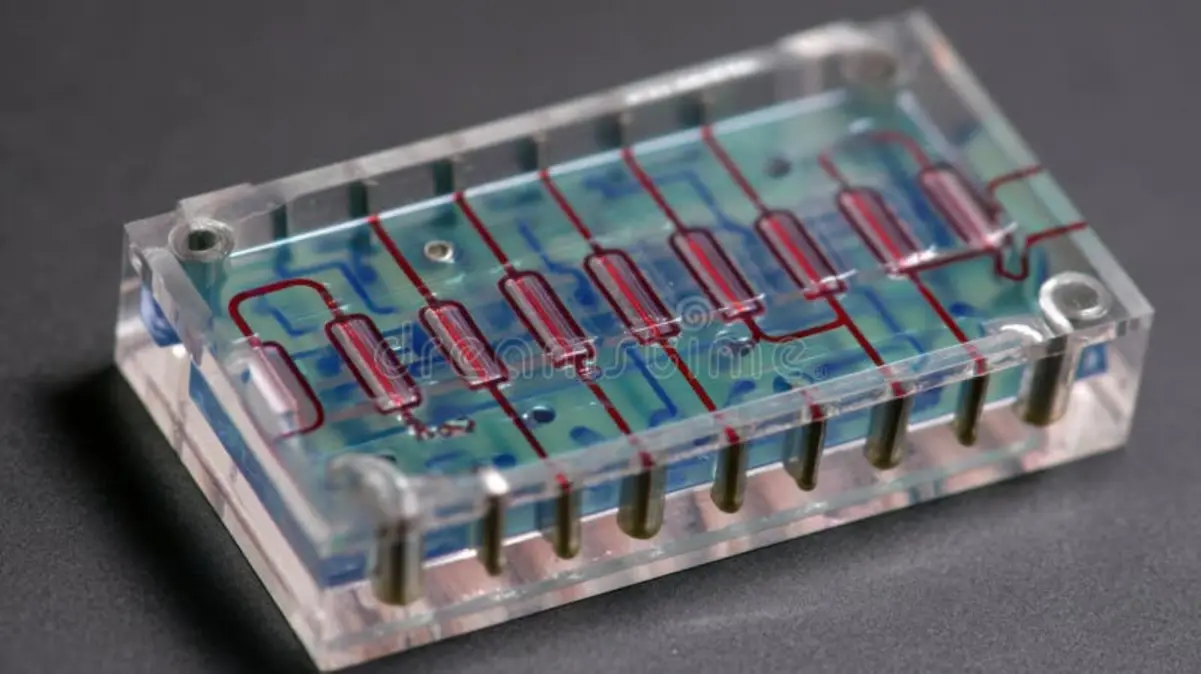
Flow Control Components: Improving Stability and Consistency
Ensuring flow control reliability involves careful component design, material choice, and assembly process control.
Pump and valve tips:
- Use robust, commercially available pumps and valves where possible
- Minimize dead volume and avoid sharp corners prone to bubble trapping
- Design channels for smooth flow transitions and venting
- Regularly calibrate pressure sources
- Where bubbles pose consistent risk, consider degassing fluids or integrating bubble traps into device layout
Materials: Impact on Biocompatibility and Performance
Common device materials include PDMS, thermoplastics (such as PMMA, COC, or PC), and glass or silicon. Every option involves trade-offs:
- PDMS: Easy fabrication and transparency, but high absorption and leaching; poor for some clinical reagents
- Thermoplastics: Superior for mass production and stable structural properties, but require careful process setup
- Glass/Silicon: Inert, biocompatible, and optically clear, but high cost and less flexibility
Selecting the appropriate material depends on the assay chemistry, anticipated production scale, and end-user needs. Surface treatments or coatings may be used to improve biocompatibility or minimize fouling, but these add process complexity and validation requirements.
Quality Assurance and Testing
Manufacturers use a range of tests to qualify microfluidic devices pre- and post-assembly:
- Leak and pressure testing
- Flow rate calibration checks
- Visual and microscopic inspection for channel defects or debris
- Functional assays with simple test fluids or surrogate samples
- In some applications, aging or environmental cycling to predict in-field durability
Early, automated batch testing—particularly for connection integrity and flow—can dramatically improve detection of faulty units before devices ship.
Innovations and Future Directions
Several engineering and process trends aim to improve both reliability and scalability:
- Standardized Interconnection Schemes: Industry efforts to agree on edge connector designs simplify integration and reduce custom part risk.
- Hybrid Devices: Combining multiple materials or manufacturing methods to tailor channel properties and interface robustness.
- Automated Assembly and QC: Robotics and inline imaging for repeatable bonding, filling, and leak testing.
- Digital Twins & Simulation: Upfront use of CFD and FEA modeling to optimize flow and stress distribution, reducing the need for extensive pilot batches.
- Green Manufacturing: Adoption of solvent-free bonding and recyclable materials, particularly for disposable diagnostics.
Conclusion: Key Points for Improving Microfluidic Device Reliability and Manufacturability
- Address flow control and interconnection as primary risks—optimize channel and connection design for your chosen manufacturing process from the start.
- Select materials with attention to both assay compatibility and process scalability.
- Build process validation and QC testing into each stage—from prototyping to high-volume production.
- Use engineering modeling to predict and prevent common failure modes, saving time and resources during scale-up.
By focusing on design-for-manufacture principles and robust process control, teams can overcome the most persistent challenges in microfluidic device reliability and successfully translate complex lab designs into dependable clinical and commercial tools.