Quality & Testing, Regulation & Standards, Design & Development
Sterile Barrier System Validation Testing: Choosing Integrity, Microbial Barrier, and Worst-Case Tests
Updated

Sterile barrier system validation testing is often described as if it were one activity: test the package, prove it is sterile, and assign a shelf life. In practice, the evidence comes from several different tests, each answering a narrower question.
A seal-strength result does not prove microbial barrier performance. A bubble test does not establish the quality of a porous material. Accelerated aging does not show that a package can survive distribution. And a “worst-case package” is not always the same package for every part of validation.
A useful validation plan starts by defining the failure mechanism that each study is intended to address. ISO 11607 provides the overall framework for terminally sterilized medical device packaging; the selected methods and samples should then provide evidence for the actual package design, sterilization process, distribution route, and shelf-life claim.
Start with the functions of the sterile barrier system
The sterile barrier system is the minimum package that prevents microorganism ingress and allows aseptic presentation at the point of use. A pouch, tray-and-lid system, or header bag may be a sterile barrier system. A carton, shipper, insert, or dust cover may protect that barrier system but is not necessarily the sterile barrier itself.
For validation planning, separate the packaging functions:
| Function to demonstrate | Typical question | Examples of evidence |
|---|---|---|
| Seal quality and opening behavior | Are seals consistently formed and strong enough for the intended use? | Seal-strength testing, visual inspection, seal-failure analysis |
| Package integrity | Does the finished package have a leak path through a seal or package surface? | Bubble emission, dye penetration, validated visual inspection |
| Porous-material microbial barrier | Does the porous substrate resist bacterial penetration as intended? | Microbial ranking of the porous material |
| Sterilization compatibility | Does the package retain required performance after the validated sterilization exposure? | Post-sterilization package testing and material assessment |
| Shelf-life stability | Does package performance remain acceptable through the claimed shelf life? | Accelerated and real-time aging with post-aging evaluation |
| Distribution performance | Does the packaging system protect the sterile barrier through handling, transport, and storage hazards? | Distribution simulation followed by package inspection and testing |
This structure prevents a common mistake: treating a single test result as evidence for a different packaging function.
Seal strength is not the same as package integrity
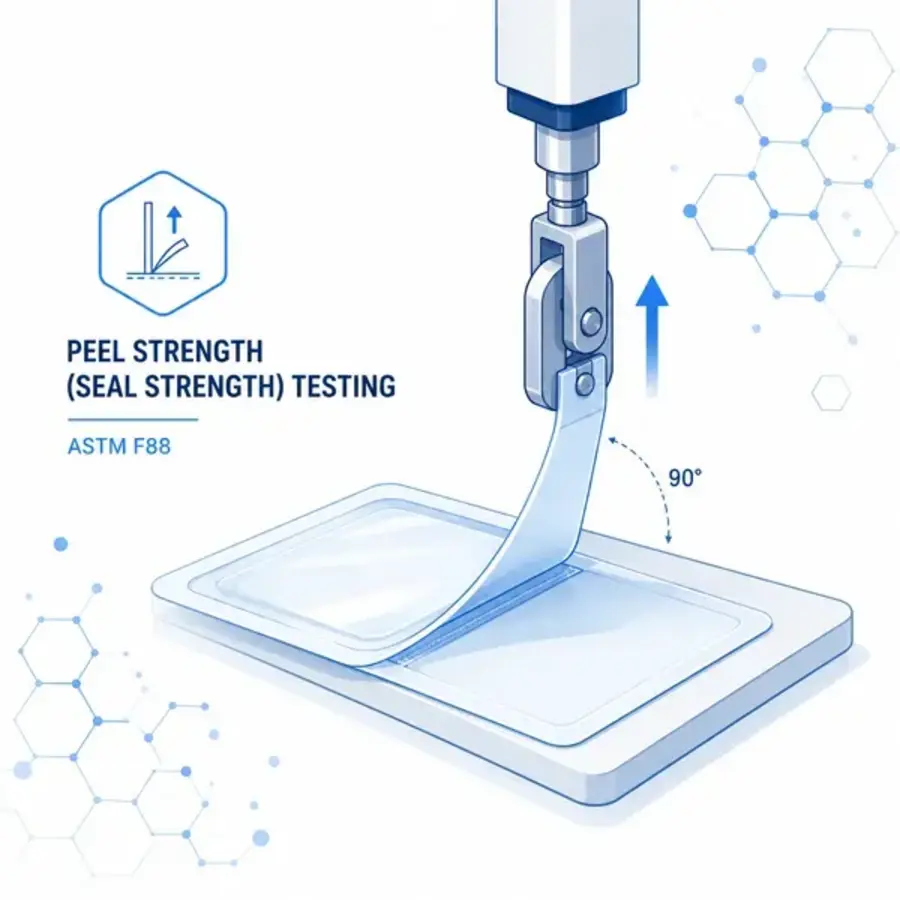
Seal-strength testing measures the force required to separate a seal. It is useful for developing the sealing process, setting acceptance criteria, monitoring production performance, and evaluating whether the package can be opened as intended.
A seal may have acceptable average peel strength while still containing a localized channel, wrinkle, void, or discontinuity. Conversely, a strong seal is not automatically a good seal. Excessive heat, pressure, or dwell time can damage materials, create brittle interfaces, distort a porous substrate, or make aseptic opening difficult.
Seal-strength work should therefore examine more than a numerical value. The study should define:
- The test method and specimen preparation approach.
- The seal locations sampled, including corners, transitions, and difficult-to-seal areas.
- The expected mode of failure, such as adhesive, cohesive, material tear, or delamination.
- Minimum and, where appropriate, maximum acceptance criteria.
- Visual characteristics that indicate unacceptable sealing conditions.
- The relationship between test results and the qualified sealing process window.
ISO 11607-2 addresses validation of forming, sealing, and assembly processes. That work should establish that equipment, materials, settings, and operators can repeatedly produce seals meeting defined requirements. Testing only at nominal settings is rarely enough for process characterization. The practical objective is to identify the operating range in which acceptable seals are consistently made.
What ASTM F2096 tells you about a package
ASTM F2096 is a bubble-emission method for detecting gross leaks in porous medical packaging by internal pressurization. The package is pressurized and submerged in water. A continuous stream of bubbles from a single location can indicate a leak path through a seal or package surface.
This makes F2096 a package-integrity method. It assesses the finished package, not simply the seal coupon and not the microbial barrier property of a porous material.
It is particularly useful when the failure concern is a gross defect such as:
- A channel in a heat seal.
- A pinhole or puncture in a flexible package.
- A damaged tray lid interface.
- A leak caused by handling, aging, or distribution exposure.
The method needs disciplined interpretation. Porous materials naturally pass air. Creasing or folding of some porous sheets can create internal sheet separation that changes air flow during testing. That observation may look like a package failure even when it does not create a route from the package interior to the external environment.
Do not dismiss a bubble-emission result automatically, but do investigate it. Document the bubble location, inspect the package, and use an appropriate confirmatory approach where needed. The most useful corrective action may be a package-design change, such as preventing folding of the porous barrier material inside a shelf carton, rather than changing a test limit.
What ASTM F1608 does—and does not—show
ASTM F1608 evaluates microbial barrier performance of porous packaging materials using an exposure-chamber method. Its output is used to rank the ability of a porous substrate to resist bacterial penetration under the conditions of the method.
This is important evidence when selecting and qualifying a porous sterile barrier material. It is not a whole-package leak test.
A porous material can show suitable microbial barrier properties while a finished pouch still has a channel in a seal. Equally, a package can pass an integrity test while the underlying porous material has not been adequately characterized for its microbial barrier role.
For this reason, ASTM F1608 and package-integrity methods are complementary, not interchangeable:
- Use microbial barrier testing to understand the porous material.
- Use integrity testing to look for physical breaches in the completed package.
- Use seal-strength testing to characterize seal robustness and opening behavior.
- Use performance and stability studies to determine whether those properties remain acceptable after real-world stresses.
Microbial challenge testing should be selected because it answers a defined risk question, not because it seems more directly related to sterility. A physical integrity method may be more suitable for many seal and surface-defect risks. More specialized microbial challenge work may be justified for particular closure designs or tortuous paths, but the rationale should be specific and documented.
Include sterilization exposure before judging package performance
The sterile barrier system must work after the actual terminal sterilization process, not only as manufactured. Sterilization can alter material properties, seal behavior, adhesive performance, coating characteristics, or package geometry.
The validation plan should identify the sterilization modality, validated cycle conditions, number of exposures where relevant, and the package configuration used during sterilization. The post-sterilization test set should be selected based on credible failure modes. Typical evaluations include visual inspection, seal strength, integrity testing, and functional assessment of the packaged device where packaging may affect device condition.
Do not assume that a material is compatible with ethylene oxide, radiation, or steam simply because a similar material has been used elsewhere. Compatibility depends on the complete material construction, sterilization exposure, sealing process, device contents, and claimed storage conditions.
Aging studies show stability, not transport resistance
Accelerated aging, commonly planned using ASTM F1980 principles, supports a shelf-life claim by exposing packaging to elevated temperature for a calculated duration. It can provide earlier evidence while real-time aging continues.
Accelerated aging is not a substitute for real-time aging, and it is not a general abuse test. The elevated condition must be justified for the materials in the package. Temperatures that approach material transitions or create unrealistic degradation can produce results that are not representative of normal storage.
For an aging study, define:
- The claimed shelf life and labeled storage conditions.
- The aging temperature, duration, and calculation assumptions.
- The package configuration and device contents, or a documented rationale for their absence.
- The post-aging test methods linked to expected aging risks.
- The real-time aging plan and retained samples.
Post-aging tests often include integrity, seal strength, visual inspection, and package-opening assessment. Repeating ASTM F1608 at every aging interval is not automatically necessary. It becomes more relevant when aging or sterilization could plausibly change the porous material structure or its microbial barrier performance. Where aging risk is mainly seal relaxation, adhesive change, film embrittlement, or device-induced stress, integrity and seal evaluations may be the more direct evidence.
Define worst case separately for each validation question
“Worst case” is useful only when it identifies the configuration most likely to reveal a particular failure. One package is not automatically worst case for all studies.
Worst case for package design and product interaction
For a family of packages, consider the device configuration that imposes the greatest stress on the sterile barrier. This may be the heaviest device, the sharpest feature, the largest mass, the most rigid component, the configuration with the greatest number of fittings, or the device most likely to contact a seal or lid during transport.
A small device may also be worst case if it has a long unsupported pouch area that can wrinkle or fold. The rationale must consider the actual load paths, clearances, and protective features rather than assuming that the largest device is always the most challenging.
Worst case for sealing-process validation
For sealing validation under ISO 11607-2, the concern is whether the forming, sealing, or assembly process can make acceptable packages over its qualified operating conditions. The critical cases may be minimum and maximum seal area, difficult corner geometry, the lowest and highest practical temperature settings, or material lots representing permitted variation.
This is different from choosing the device most likely to puncture a pouch during shipment.
Worst case for performance testing
ISO 11607-1 requires performance testing on packaging systems containing the worst-case sterile barrier system and worst-case protective packaging. The focus is the complete packaging system under handling, distribution, and storage hazards.
The worst protective package may be a carton with the least cushioning, greatest stacking load, largest unsupported span, or most challenging orientation. The worst sterile barrier system may be the pouch or tray configuration most exposed to those hazards. They should be assessed together as the shipped system.
A useful worst-case selection record should state:
- The package family and the configurations included.
- The test objective and failure modes being addressed.
- The variables that differ across the family.
- The selected configuration or configurations.
- Why those samples represent the greatest challenge.
- Why untested configurations are bounded by the selected cases.
If the rationale requires two or more configurations, use them. A reduced test matrix is acceptable only when it remains scientifically and technically defensible.
Build a linked validation matrix
The strongest validation programs connect design risks, test methods, samples, and acceptance criteria in one matrix. Avoid a list of standard numbers with no explanation of what each test is intended to demonstrate.
For every study, ask four questions:
- What failure could allow loss of sterile barrier performance or prevent aseptic presentation?
- Which test can detect or characterize that failure?
- At what point should the package be tested: post-sterilization, post-aging, post-distribution, or more than one point?
- Which package and process configuration creates the most credible challenge?
This approach keeps ASTM F2096, ASTM F1608, seal testing, aging, sterilization exposure, and distribution testing in their proper roles. The goal is not to run every available method. It is to assemble clear, risk-based evidence that the sterile barrier system can be manufactured consistently, withstand expected lifecycle stresses, and maintain its intended function until use.