Materials, Manufacturing, Quality & Testing, Design & Development
TPE Bonding and Overmolding Failures: Choosing Materials, Treatments, and Process Controls
Updated
A TPE overmold can look acceptable when it leaves the press and still fail in service. The soft layer may peel from the rigid body, become sticky, lose printed markings, or show large lot-to-lot changes in adhesion. These are rarely solved by one adjustment to melt temperature or one surface-treatment step.
Reliable TPE bonding and overmolding starts with a compatible material pair. Processing, part design, cleanliness, and aging control then determine whether that compatibility becomes a durable bond. This is particularly important for medical-device housings, grips, seals, wearable components, connectors, and handheld instruments, where cleaning exposure, flexing, marking durability, and visual quality can all matter.
Start with the bonding mechanism
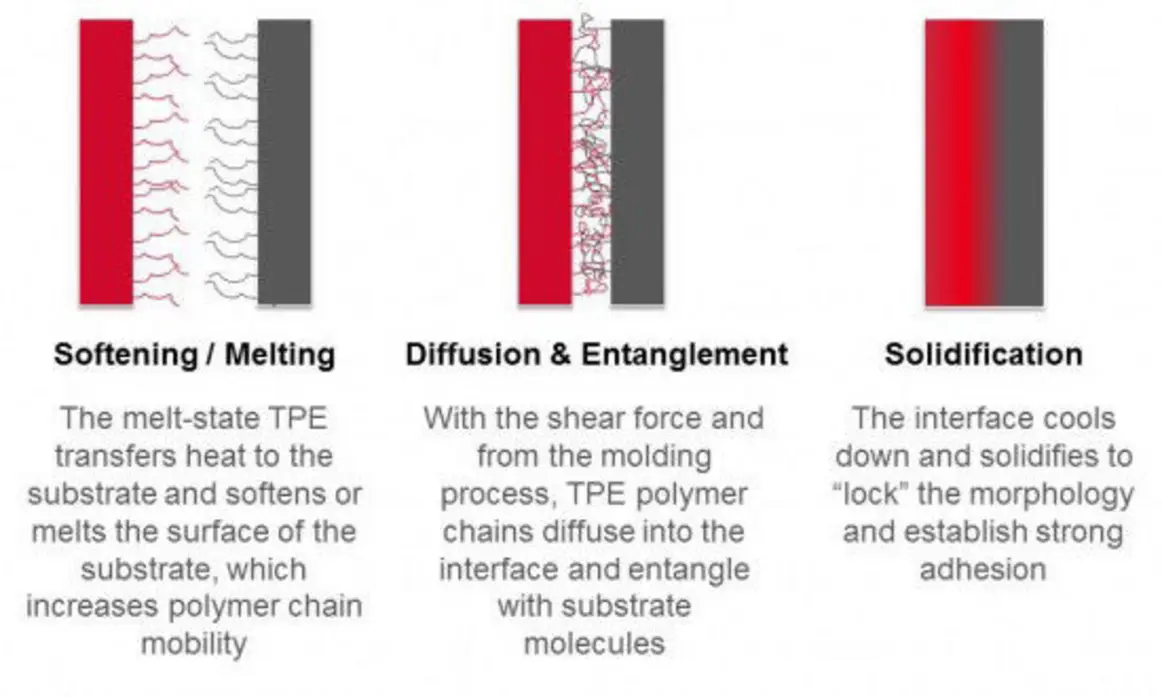
Direct TPE overmolding is not simply the soft material mechanically gripping a hard surface. During the second shot, heat from the TPE must wet and soften the substrate surface sufficiently for molecular interaction and interdiffusion at the interface. This melt adhesion depends primarily on the chemistry of both grades, not just on their generic resin names.
A TPE formulated to bond to polypropylene may bond strongly to one PP grade and poorly to a different PP compound containing high levels of filler, lubricant, recycled content, or mold-release residue. The same issue is more pronounced with engineered substrates such as nylon, PC/ABS, or PBT.
Material family names are therefore only a starting point. A data sheet that says “TPE” and “nylon” does not establish that two proposed grades will bond in a specific tool and process.
Material compatibility comes before surface treatment
As a broad rule, similar polymer chemistry is easier to bond through overmolding:
| Rigid substrate | Typical overmold direction | Key limitation |
|---|---|---|
| PP | PP-bonding SEBS TPE or TPV | Additives, surface contamination, and incompatible color carriers can reduce adhesion. |
| PE | Specialty PE-bonding TPE | Low surface energy makes grade selection and treatment control important. |
| ABS, PC, PC/ABS | Specialty TPE or TPU grades designed for polar substrates | Stress cracking, cosmetic defects, and colorant incompatibility may appear. |
| PA6 or PA66 | Amide-compatible TPE or TPU grades | Moisture, reinforcement, heat stabilizers, and surface fiber exposure affect results. |
| PBT | Specialty compatible TPE or TPU grades | Grade-specific testing is needed; thermal conditions can be limiting. |
| POM/acetal | Mechanical retention normally required | Direct chemical adhesion is generally difficult and should not be assumed. |
This table is a screening tool, not a material release decision. Obtain the TPE supplier’s recommended bonding grades for the exact substrate formulation, including its filler level, flame-retardant package, color concentrate, stabilizers, and recycled-content policy.
For medical applications, also evaluate the full material system against product requirements. A resin that bonds well is not automatically suitable for the required cleaning agents, sterilization method, skin contact duration, extractables assessment, or regulatory documentation.
Choose the TPE formulation for more than hardness
A common mistake is to select the softest grade that meets a tactile requirement, then attempt to recover bond strength through hotter processing. Softness alone does not define bonding, grip, flexibility, coating acceptance, or long-term surface behavior.
Ask the compound supplier for data on the following properties:
- The intended rigid-substrate family and specific compatible grades.
- Recommended melt temperature and mold-temperature range for overmolding.
- Oil or plasticizer content and the risk of surface migration.
- Compression set, tensile strength, tear resistance, abrasion resistance, and flex performance.
- Colorant and masterbatch carrier recommendations.
- Resistance to the device’s expected cleaners, disinfectants, skin oils, drugs, and environmental exposures.
- Printing, coating, laser-marking, or pad-printing guidance.
A low-durometer oil-extended TPE can create a pleasant soft feel but may be more likely to exhibit migration-related problems. Migrating low-molecular-weight components can make a surface feel greasy or tacky, interfere with inks and coatings, and weaken an adhesive interface over time. This is a formulation issue first. Surface activation can improve initial wetting, but it cannot reliably compensate for a migrating surface chemistry.
Hardness is also not a reliable proxy for flexibility. Two materials with the same Shore A hardness can have materially different modulus, recovery, tear resistance, and coating strain requirements. Specify the actual functional requirement: for example, flexural stiffness, grip coefficient, elongation at expected use strain, or compression-set limit.
Control the substrate, not only the TPE
The rigid first shot is part of the bonding system. Its surface condition can determine whether a validated TPE grade succeeds in production.
Avoid interface contaminants
Mold-release agents, silicone aerosols, lubricants, handling oils, dust, moisture, and packaging residues can block wetting at the interface. A part can still appear fully covered by TPE while the bond is weak enough to peel cleanly.
Build simple controls into the manufacturing route:
- Do not use external release agents on bonding surfaces unless they have been specifically qualified.
- Keep inserts protected after molding and before overmolding.
- Use clean gloves or automated handling where fingerprints or oils are a concern.
- Define cleaning methods and verify that cleaning leaves no damaging residue.
- Segregate untreated parts from treated parts and identify their processing time window.
Filled substrates need particular attention. Glass fiber, mineral filler, lubricants, and other additives can reduce the amount of base polymer available at the surface. With glass-filled nylon, for example, exposed fibers and variable surface composition may reduce peel strength. A bonding-grade TPE may still be feasible, but mechanical retention should usually support the interface.
Use surface treatment for a defined purpose
Atmospheric plasma, corona, flame treatment, and primers can increase surface energy and improve wetting. They are useful when bonding or printing low-energy surfaces, especially polyolefin-rich materials. Their benefits depend on part geometry, treatment uniformity, incoming cleanliness, and time before the next process.
Surface treatment should be treated as a controlled manufacturing step, not a general cure for incompatibility. Define:
- The surface to be treated and the required treatment coverage.
- The process settings and equipment verification method.
- A practical acceptance measure, such as a validated wetting or surface-energy method where appropriate.
- The maximum treatment-to-bond or treatment-to-print interval.
- Handling and storage conditions during that interval.
Activated polymer surfaces can lose some of their increased surface energy over time through molecular rearrangement or contamination pickup. If a treated insert bonds well in a laboratory trial but fails on the production line, compare the actual delay between treatment and molding. Moving treatment immediately upstream of overmolding can be more effective than increasing treatment intensity.
Heat, insert temperature, and melt delivery determine interface formation
Once the materials are compatible and clean, the process must provide enough thermal energy and contact pressure for the TPE to wet the substrate. Low melt temperature and cold inserts are common causes of clean interfacial peeling.
Two-shot molding generally provides a favorable condition because the substrate remains relatively warm and the second shot follows quickly. Insert molding introduces more opportunity for inserts to cool, collect contamination, or vary in temperature while waiting for loading.
Monitor the temperatures that matter
Do not rely only on barrel setpoints. Establish and control:
- Actual TPE melt temperature within the supplier’s processing range.
- Mold temperature near the bonding zone.
- Insert temperature when using separately molded rigid parts.
- Time between first-shot molding and overmolding.
- Residence time and evidence of thermal degradation.
- Material drying conditions for hygroscopic resins and TPE grades that require drying.
Higher TPE melt temperature often improves adhesion because it improves wetting and interfacial diffusion. It also raises risk. Excessive melt temperature, long residence time, or excessive shear can degrade the TPE, cause discoloration, generate odor, alter surface tack, or create low-molecular-weight degradation products. Raise temperature within the validated material window and assess both bond strength and surface quality after aging.
A uniformly preheated insert can improve adhesion in insert molding, but the preheat method must not warp the substrate, change dimensions, introduce contamination, or exceed any material-specific limits. Measure actual insert temperature at the bonding area rather than assuming oven settings represent the part.
Injection speed, pressure, venting, and gate location
The TPE needs to contact the substrate while hot and flow without trapping gas. A faster injection rate can support wetting, provided it does not displace inserts, flash the tool, cause jetting, or deform the substrate. Packing should be sufficient to maintain intimate contact until the gate freezes, but excessive holding pressure can create cosmetic problems, distortion, or residual stress.
Poor venting at end-of-fill can produce a weak bond zone even where the rest of the part adheres well. Map failures to flow direction, gate location, and weld-line positions. A localized peel failure often points to a tool or fill problem rather than a global material mismatch.
Design the interface to resist peeling
A strong chemical bond is valuable, but it should not be the only feature holding the TPE in place where the product can be pried, flexed, pulled, or repeatedly cleaned.
Use mechanical retention where geometry and use conditions allow:
- Through-holes, windows, or slots filled by the TPE.
- Wraparound features that prevent edge lift.
- Undercuts designed for demolding and TPE flow.
- Ribs or recesses that support the soft layer without creating thin, peelable edges.
- Termination lines positioned away from fingernail access, repeated flex zones, and fluid exposure.
Avoid abrupt TPE termination at a highly stressed corner. Thick-to-thin transitions, sharp edges, and insufficient shut-off control can initiate curl and peeling. Also consider the TPE thickness. Very thin soft layers may feel harder than expected because the rigid substrate dominates the tactile response, while thin edges are more vulnerable to delamination.
Solve sticky surfaces and inconsistent marking separately
A sticky surface is not automatically a bonding defect. It can result from excessive oil extension, additive migration, thermal degradation, incompatible colorants, incomplete cooling, surface contamination, or an intentional high-friction formulation that exceeds the product requirement.
First distinguish between material behavior and process damage. Compare retained samples from the incoming resin lot, early production, and aged parts. Check whether tack is uniform, concentrated near gates, associated with a particular color, or increased after elevated-temperature storage. Gate-adjacent tack can suggest overheating or residence-time issues. Tack that develops over time across the part can suggest migration.
Printing and coating failures follow similar logic. Ink that initially adheres but peels after days or weeks may be affected by migration into the ink layer, inadequate treatment, contamination, or a coating that cannot stretch with the TPE.
For printed markings:
- Use ink, coating, or primer systems specified for the exact TPE family.
- Match coating elongation and flex capability to the actual strain of the part.
- Treat and print within a controlled time window.
- Validate cure conditions and avoid assuming a hard, dry surface means full adhesion.
- Test after exposure to representative cleaners, flexing, abrasion, temperature cycling, and aging.
Laser marking can also be inconsistent on natural or lightly filled TPE grades because many materials have limited intrinsic absorption at common marking wavelengths. A laser-markable compound may be needed, but its additive package must be evaluated for color, mechanical properties, migration, and any applicable device requirements.
Use peel testing to identify the failure mode
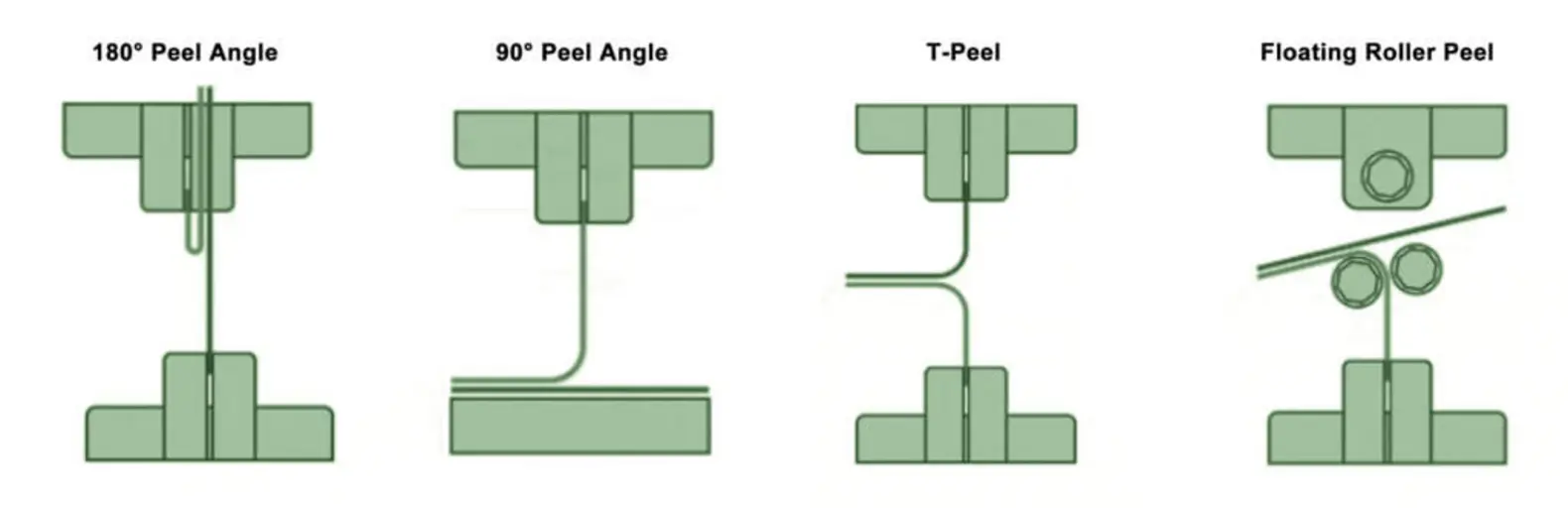
A peel-strength number is useful only when the test geometry, peel angle, conditioning, speed, specimen dimensions, and failure mode are consistent. Define a product-specific method or use an applicable recognized method with controlled specimen preparation.
The failure appearance matters as much as the force:
- Adhesive failure: The TPE separates cleanly from the rigid substrate. This points toward insufficient compatibility, contamination, inadequate heat, poor wetting, or a process interruption.
- Cohesive failure: The TPE tears or leaves material on the substrate before the interface separates. This generally indicates that the interface is stronger than the bulk TPE in that test condition.
- Mixed failure: The failure changes along the peel path. Investigate local variation in fill, venting, surface condition, insert temperature, or part geometry.
Test parts after relevant conditioning, not only immediately after molding. Depending on the intended device environment, this may include temperature cycling, humidity exposure, chemical contact, repeated flexing, cleaning cycles, or accelerated aging. The aim is not simply to reach a high initial peel value; it is to confirm that the chosen material and process retain suitable performance throughout use.
A practical troubleshooting sequence
When an established overmold begins to peel or marks become inconsistent, change one major variable at a time and retain comparison samples. This sequence usually finds the cause faster than changing temperature, pressure, and treatment settings together.
- Confirm material identity. Verify both resin grades, lot numbers, colorants, dryers, regrind level, and any substitutions.
- Inspect the failure mode. Determine whether separation is clean, cohesive, localized, or associated with a gate, edge, or flow end.
- Check substrate surface condition. Review mold release, handling, cleaning, storage, treatment coverage, and time since treatment.
- Compare actual process values. Check melt temperature, mold temperature, insert temperature, injection profile, hold profile, cycle time, and residence time.
- Review tool conditions. Examine venting, shut-offs, gate balance, flash, wear, and insert positioning.
- Evaluate aging behavior. Separate immediate failures from those that appear after heat, cleaning, flexing, or storage.
- Add or improve mechanical retention if needed. Do not rely on chemistry alone in a peel-prone design.
The durable solution is usually a matched system: a bonding-grade TPE selected for the actual substrate formulation, a clean and controlled interface, enough heat for wetting without degradation, a tool that vents and fills consistently, and geometry that prevents edge peeling. Treating TPE overmolding as a system rather than a single material choice is what turns a promising sample into repeatable production.