Manufacturing, Quality & Testing, Medical Devices
Ultrasonic Cleaning Process Parameters: Preventing Hot Spots, Dead Zones, and Component Damage
Updated
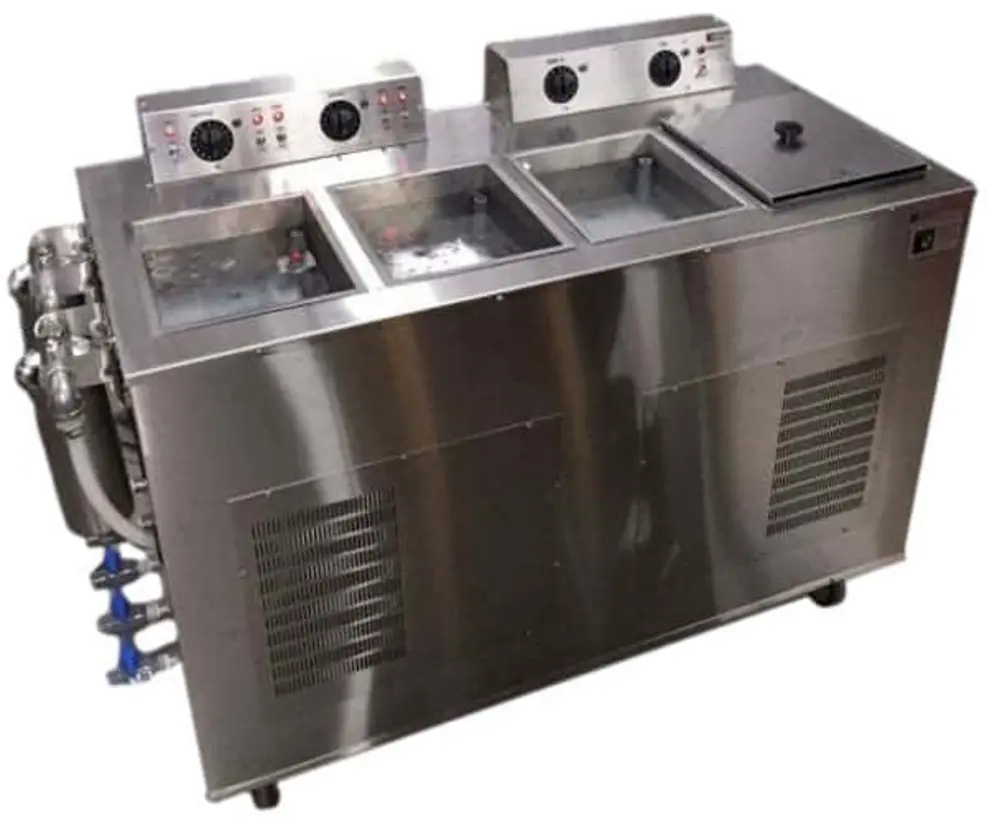
Ultrasonic cleaning can remove oils, particles, polishing residues, and other soils from complex medical-device components. It can also produce inconsistent results when the tank, chemistry, load, and operating settings are treated as separate decisions.
A part that looks clean at one basket location and fails in another may be experiencing a dead zone. A polished surface that becomes dull or etched may be receiving too much cavitation energy. Raising power, temperature, or cycle time may worsen either problem.
The practical objective is not maximum cavitation. It is a repeatable cleaning process that delivers the required cleanliness level without changing the component’s surface, dimensions, function, or material condition.
Start with the cleaning requirement and the part risk
Before selecting a frequency or specifying a tank, define what must be removed and how cleanliness will be assessed. “Visually clean” is not enough for many medical-device manufacturing operations. The process may need to control visible residue, nonvolatile residue, particles, machining oils, process chemicals, or contamination within internal passages.
Also identify surfaces that can be harmed by aggressive cavitation or unsuitable chemistry. These may include:
- Thin-wall metal parts and fine wire forms
- Aluminum, brass, copper, and other relatively soft alloys
- Polished, ground, or cosmetic surfaces
- Plated, coated, bonded, or laser-marked areas
- Delicate assemblies, MEMS devices, sensors, and electronic components
- Narrow lumens, blind holes, threads, porous structures, and internal channels
Cleaning risk comes from the combined process exposure, not frequency alone. A robust stainless steel component with heavy machining oil may tolerate a process that would visibly damage a polished aluminum housing or disturb a delicate bonded assembly.
For finished medical devices, cleaning is also not the same as disinfection or sterilization. If a process is part of device reprocessing or manufacturing contamination control, its intended use and validation requirements need to be defined separately.
Frequency changes cavitation behavior, not just cleaning speed
Ultrasonic transducers create alternating pressure waves in the liquid. During low-pressure portions of the wave, small cavities form. Their collapse produces the localized mechanical action that helps detach contamination.
At lower frequencies, cavitation bubbles are generally larger and collapse more forcefully. At higher frequencies, bubbles are generally smaller and cavitation is less mechanically aggressive. This is useful as a starting principle, but it is not a complete equipment specification.
| Nominal range | Typical cleaning behavior | Common fit | Main risk when misapplied |
|---|---|---|---|
| About 20–30 kHz | Strong, coarse cavitation | Heavy oil, carbon, scale, robust metal parts | Surface erosion, pitting, damage to coatings or delicate features |
| About 35–45 kHz | Balanced general-purpose action | Many machined parts and general production soils | Can still be too aggressive for sensitive surfaces or assemblies |
| About 68–130 kHz | Finer, gentler cavitation | Precision finishes, fine particles, complex small features | May not remove heavy soils efficiently without suitable chemistry and time |
| Megasonic range | Low-implosion, high-frequency cleaning action | Very sensitive surfaces and fine-particle applications | Not generally a replacement for bulk-soil removal |
A frequency such as 40 kHz is common, but it should not become a default without evaluation. Two nominally 40 kHz systems can behave differently because of transducer layout, generator control, tank dimensions, liquid condition, power delivery, and load configuration.
Higher frequency is not automatically better. It may reduce the risk of mechanical damage and improve access to fine features, but it can also leave heavy contamination behind if the chemistry and exposure time are not sufficient. Lower frequency is not automatically faster in a useful sense; it may remove soil rapidly while creating unacceptable surface change.
Power density and exposure time set the cavitation dose
The rated electrical wattage on a cleaner is not a complete measure of cleaning intensity. What matters is how much useful acoustic energy reaches the working liquid and the component surfaces under the actual load.
Power density is often considered as power relative to tank volume or working volume. It is a useful comparison tool, but it must be interpreted with the tank’s geometry and transducer arrangement. A small tank with a high nominal wattage can create highly concentrated exposure. A large tank can be underpowered for its volume or for a dense production load.
Use the least aggressive setting that consistently meets the cleaning requirement. This creates a margin below the damage threshold and makes the process less sensitive to normal variation in solution condition and loading.
When a part is under-cleaned, avoid immediately increasing power. Check these causes first:
- Is the detergent chemically matched to the soil?
- Is the bath at its specified concentration and temperature?
- Was fresh solution adequately degassed?
- Are parts shielded by other parts, baskets, fixtures, or trapped air?
- Is the load too dense for liquid circulation and cavitation access?
- Is contamination being redeposited from an overloaded or poorly maintained bath?
Longer exposure also adds dose. A low-risk setting can become damaging when a cycle is extended without assessment. Conversely, a shorter process with better chemistry, orientation, rinsing, and bath maintenance may achieve the required result with less cavitation exposure.
Sweep operation reduces fixed hot spots and dead zones
A fixed-frequency ultrasonic tank can form standing-wave patterns. In practice, this means locations of relatively intense cavitation and locations with weaker activity. Components placed repeatedly in weak locations can come out with retained soil, while parts near intense locations may receive unnecessary exposure.
This is the origin of many apparently random batch-to-batch cleaning failures.
Frequency sweep varies operation around a nominal center frequency. The variation shifts the standing-wave pattern rather than allowing it to remain in one place. When correctly implemented, sweep can improve energy distribution and reduce persistent hot spots and dead zones.
Sweep is particularly valuable when cleaning precision components, loads with broad basket coverage, or parts with critical surfaces that cannot be repositioned easily. It does not eliminate the need for good loading practice. A component pressed against another component, held against a basket wall, or filled with trapped air may still receive poor cleaning even in a swept tank.
Some systems also offer pulsed ultrasonic operation. Duty cycling can reduce continuous heat input and may be useful where the process requires controlled exposure. Its effect depends on the generator, transducer system, bath, and application, so it should be evaluated through process development rather than assumed to improve every cleaning operation.
Chemistry and temperature should reduce the need for aggressive ultrasonics
Ultrasonics assist cleaning; they do not replace suitable chemistry. The solution must wet the component, enter the required features, dissolve or disperse the target soil, and remain compatible with the component materials.
A detergent that matches the contaminant can reduce the mechanical energy needed for cleaning. For example, oil and coolant residues may require a formulation that emulsifies or solubilizes them effectively. Fine particulate removal may depend more on wetting, dispersion, filtration, and rinsing than on higher cavitation intensity.
Concentration matters. Too little chemistry may leave soil intact and encourage operators to compensate with excessive power or time. Too much can increase cost, leave residues, create rinsing problems, or attack sensitive materials. Follow the chemistry supplier’s operating range, then establish a controlled range through process development.
Temperature also affects both chemistry and cavitation. Heating commonly improves detergent action and lowers the viscosity of oils, waxes, and other soils. However, hotter is not always better. Excessive temperature can alter cavitation behavior, increase evaporation, accelerate chemical attack, or exceed the temperature tolerance of adhesives, polymers, coatings, and assembled components.
Treat temperature as a controlled process parameter. Record the actual liquid temperature, not only the heater setpoint, because ultrasonic operation can add heat during a production run.
Freshly prepared aqueous solutions can contain dissolved gas that dampens cavitation. Allow the bath to degas according to the equipment and chemistry instructions before evaluating cleaning performance. Otherwise, early-cycle results may not represent steady-state production performance.
Tank design and part placement determine what the part actually receives
The useful cleaning zone is not necessarily the full physical volume of the tank. Tank shape, transducer location, liquid level, weirs, filtration flow, heaters, and fixtures all affect cavitation distribution and circulation.
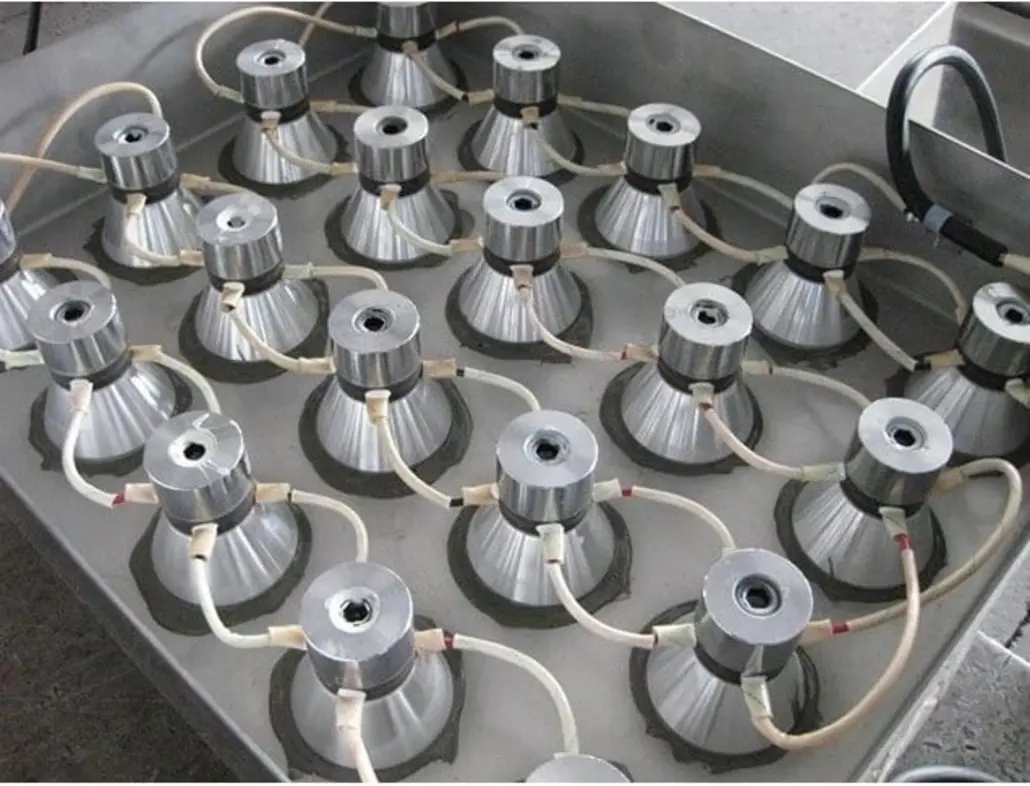
Do not place parts directly on the tank bottom. This can interfere with energy transmission, scratch the parts, and overload the tank surface. Use a suitable basket or fixture that holds components off the bottom and away from walls.
For repeatable results:
- Keep parts fully submerged at the defined operating level.
- Space parts so solution can circulate around all required surfaces.
- Avoid nested parts, part-to-part contact, and tightly packed baskets.
- Orient blind holes, lumens, and cups to let air escape and solution enter.
- Use fixtures that expose critical surfaces instead of shielding them.
- Keep the basket location consistent from run to run.
- Qualify the maximum load, not only a lightly loaded demonstration basket.
A useful development exercise is to place representative test parts or approved cleaning indicators at multiple locations and orientations in the working basket. Compare results across the load. If certain locations consistently underperform, investigate sweep capability, transducer coverage, fixture design, and load density before increasing overall energy.
Prevent damage by looking beyond visible defects
Cavitation damage may appear as dullness, haze, pitting, edge attack, coating loss, or a changed surface finish. It may also be less obvious: a bonded joint may weaken, a fine feature may deform, or a sensitive assembly may suffer functional damage.
For components with critical surfaces or functions, damage evaluation should match the risk. This can include visual inspection at an appropriate magnification, surface-finish assessment, dimensional inspection, coating evaluation, functional testing, or other product-specific checks.
The process should also include post-cleaning rinsing and drying. A clean ultrasonic bath can still produce a poor final result if detergent residue remains, dissolved soil redeposits, rinse water is poorly controlled, or drying leaves spots and particles. Multi-stage cleaning often separates wash, rinse, final rinse, and drying so that the cleaning bath does not have to perform every function.
Build a controlled ultrasonic cleaning process
A stable process defines and controls the parameters that materially affect cleaning and component condition. At minimum, document:
- Equipment identification, frequency mode, sweep or pulse setting, and power setting
- Tank working volume and defined liquid level
- Chemistry identity, concentration, bath age, and replenishment criteria
- Temperature range and cycle time
- Degassing procedure after bath preparation or solution replacement
- Basket, fixture, orientation, load quantity, and maximum packing density
- Filtration, skimming, overflow, or soil-removal controls where used
- Rinse stages, water quality, drying method, and hold times
- Cleaning acceptance criteria and component-damage acceptance criteria
During development, change one meaningful variable at a time where practical. If frequency, chemistry, temperature, time, and loading all change together, it is difficult to identify why the result improved or failed.
The final process window should include routine operating targets and allowable limits, not a single ideal setting. It should be robust enough to accommodate normal differences in operators, lot soil load, and bath aging while still meeting the defined cleanliness requirement.
The central rule is simple: specify ultrasonic cleaning process parameters as a system. Frequency, power, sweep, chemistry, temperature, tank design, and loading all shape the cavitation exposure received by the part. A controlled, appropriately gentle process is usually more reliable than one that simply applies more energy.